
A free mold inspection is usually offered by a mold remediation company. It finds the mold and the moisture behind it, and ends with a quote for the work. A paid inspection usually comes from an independent inspector with no stake in the cleanup. It often includes lab sampling and a written report, and typically costs $300 to $1,000 with sampling. Both are legitimate. Which one you need depends on what you’re trying to decide.
This guide explains how each model works, who pays for what, and how to get an honest answer from either one.
Is a Free Mold Inspection Legit?
Yes. A free mold inspection is a real inspection, but it isn’t free in the economic sense. The company covers its cost from the remediation jobs that some inspections turn into. That doesn’t make the findings wrong. It means you should know the business model, ask for specifics, and judge the inspector by what they tell you, not just by the price.
A good free inspection still uses real tools: moisture meters, humidity readings and, when needed, thermal imaging or a borescope to check inside walls. It should end with a clear explanation of where the mold is, what’s causing it, and how large the affected area is.
Why Are Some Mold Inspections Free?
Because the company makes its money on remediation, not inspections. Most free inspections come from companies that also remove mold. The inspection is how they meet you, see the problem and quote the job.
MMRG Mold Remediation & Basement Waterproofing is open about this. Its mold inspections page describes the free inspection as a loss leader, the way the company earns work, and says the inspection cost isn’t added to its contracts. The page also says MMRG doesn’t try to sell you services you don’t need. That openness is the right test for any company offering a free inspection: ask how they pay for it, and listen to whether the answer sounds straight.
What a free inspection usually doesn’t include is lab sampling. Lab fees are a real cost, often $75 to $350 per sample, so free inspections typically rely on what the inspector can see and measure on site.
What Does a Paid Mold Inspection Include?
A paid inspection is usually done by an independent inspector or indoor air quality consultant who doesn’t do the cleanup. It typically includes:
- A visual inspection and moisture survey, the same core work as a good free inspection
- Air sampling, comparing indoor spore counts with an outdoor control sample
- Surface or swab samples from suspect areas, sent to a lab to identify the type of growth
- A written report with lab results, photos and findings
- Remediation recommendations that aren’t tied to any one contractor’s quote
What it costs: the site visit alone usually runs $150 to $500, and a standard inspection with air and surface sampling about $300 to $1,000. Each lab sample adds $75 to $350 . A post-remediation clearance test usually costs $100 to $300.
Paid isn’t automatically better. If mold is already visible, the EPA says that “in most cases, if visible mold growth is present, sampling is unnecessary”. You don’t need a lab to tell you what you can see. Sampling earns its cost when it answers a real question, such as whether there’s hidden mold, whether a cleanup worked, or what you need to document for a sale or claim.
Free vs. Paid: Side by Side
| Free inspection | Paid inspection | |
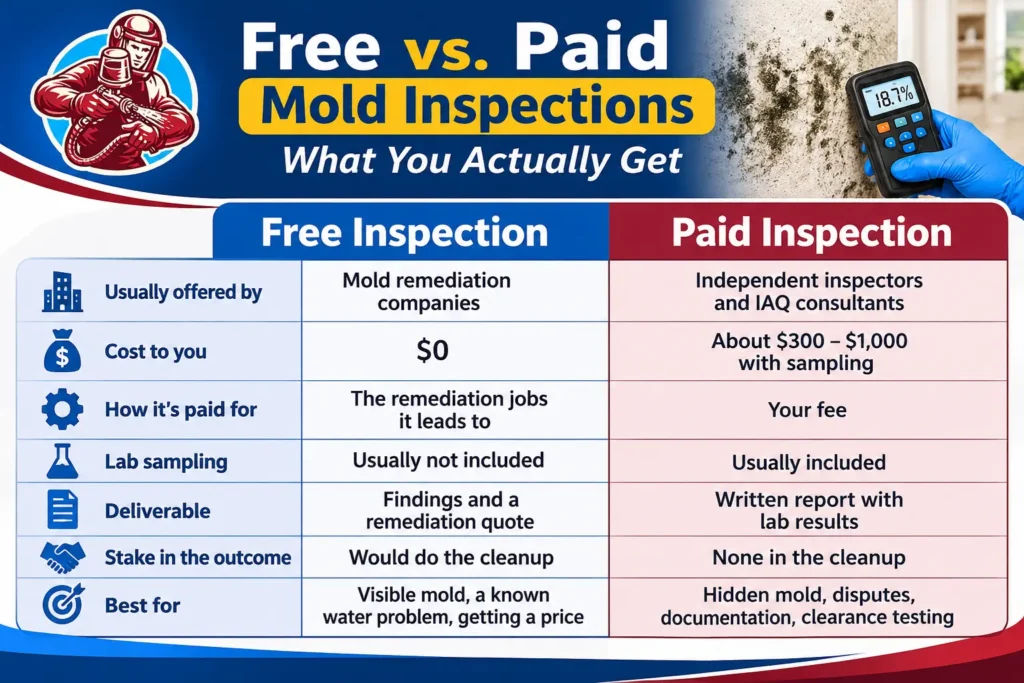
| Usually offered by | Mold remediation companies | Independent inspectors and IAQ consultants |
| Cost to you | $0 | About 300–1,000 with sampling |
| How it’s paid for | The remediation jobs it leads to | Your fee |
| Lab sampling | Usually not included | Usually included |
| Deliverable | Findings and a remediation quote | Written report with lab results |
| Stake in the outcome | Would do the cleanup | None in the cleanup |
| Best for | Visible mold, a known water problem, getting a price | Hidden mold, disputes, documentation, clearance testing |
Should the Company That Inspects Also Remove the Mold?
It depends on the state. Some states won’t allow it. New York’s law says: “No licensee shall perform both mold assessment and mold remediation on the same property”. Texas has a similar rule: “A license holder may not perform both mold assessment and mold remediation on the same project”.
New Jersey has neither a mold license nor a rule like this. Bills to create state certification, including S574 in 2020 and S1030 in 2024, haven’t passed according to the records we reviewed. In NJ, the same company can legally inspect and remediate, and that’s how most free inspections work.
That’s not a reason to avoid free inspections. It’s a reason to protect yourself:
- Ask for the findings in writing: affected areas, square footage and the moisture source.
- Ask why each part of the quote is needed, especially material removal and testing.
- Get a second quote on larger jobs.
- For large or high-stakes jobs, consider an independent clearance test after the work is done.
A company that’s confident in its work won’t mind any of this.
When a Free Inspection Is Enough, and When to Pay
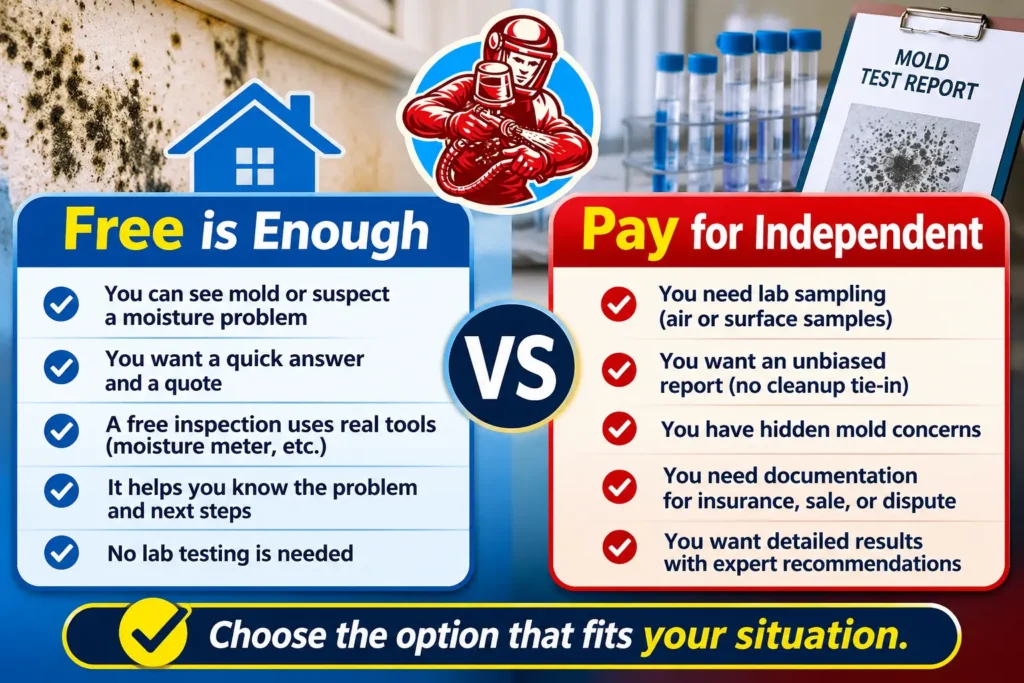
A free inspection is usually enough when:
- You can see the mold and want to know how far it goes and what it will cost to fix
- There’s an obvious water source, like a leak, seepage or a past flood
- The affected area looks modest and you plan to compare a couple of quotes
Pay for an independent inspection when:
- You smell mold but can’t find it, and want sampling to confirm hidden growth
- You’re buying or selling a home and need documentation both sides will accept
- You’re filing an insurance claim, or in a dispute with a landlord, tenant or contractor
- Someone in the home has health concerns and a doctor wants data
- You’ve received a large remediation quote and want an unbiased second opinion
- The remediation is finished and you want independent confirmation it worked
What Any Mold Inspection Should Give You
Free or paid, you should leave with:
- Where the mold is, and roughly how many square feet are affected
- The moisture source, or the most likely one
- Moisture and humidity readings for the problem areas
- Photos of what was found
- Whether sampling was done, and why or why not
- A recommended next step and, from a remediation company, a written scope and price
If an inspection ends with a price but no clear explanation of the problem, ask for one before you agree to anything.
Emergency Mold Inspection Service
Two situations can’t wait for a slow scheduling process. One is fresh water damage: the EPA advises discarding anything that has stayed wet for more than 24–48 hours, which is also when mold starts to take hold. The other is a home-sale deadline, where an inspection contingency gives you days, not weeks.
After flooding or a burst pipe, extraction and drying come first. MMRG provides 24/7 emergency water extraction, then checks the area for mold once it’s dry. For a real estate deadline, say so when you call, and ask for the findings in writing so you can share them with the other side.
Book a Free Mold Inspection in Monmouth County
MMRG offers free mold inspections across New Jersey from its base in Ocean Township, covering Monmouth County towns including Holmdel, Middletown, Eatontown, Long Branch and Rumson. Inspections are led by Randy Cece, a Certified Mold Assessor (EAA) and Indoor Air Quality Technician (ESA) with documented training dating back to 2002. MMRG holds IAQ, ESA and IICRC certifications.
You’ll get a straight explanation of what’s there and what’s causing it. If you can see the mold, nobody will push lab tests on you. The inspection cost isn’t folded into your contract. If remediation is needed, the price is backed by a 10% price-match guarantee, so you can compare quotes with confidence.
Book your free mold inspection. Schedule through our Emergency mold inspection Service page or call Randy at 908-601-1307.
I. FAQ
Does a free mold inspection include mold testing?
Usually not. Lab sampling carries real lab fees, so most free inspections rely on visual checks, moisture readings and thermal imaging. If you need sampling, for hidden mold, documentation or clearance, expect to pay for it, or ask whether the company can arrange it.
How long does a mold inspection take?
Most take one to a few hours, depending on the size of the home and how many areas need checking. Lab results from a paid inspection usually take a few business days after the visit.
Is there an obligation after a free inspection?
There shouldn’t be. You’re entitled to the findings and a written quote, and you can take them to other companies. If anyone pressures you to sign on the spot, treat it as a warning sign.
Can I use a free inspection and still hire someone else?
Yes. A clear free inspection with a written scope is a useful baseline for comparing quotes from other remediation companies.
Does homeowners insurance pay for a mold inspection?
Sometimes, when the mold results from a sudden, covered event like a burst pipe and the insurer needs the inspection to assess the claim. Check with your insurer before booking a paid inspection, and document the damage with photos first.