
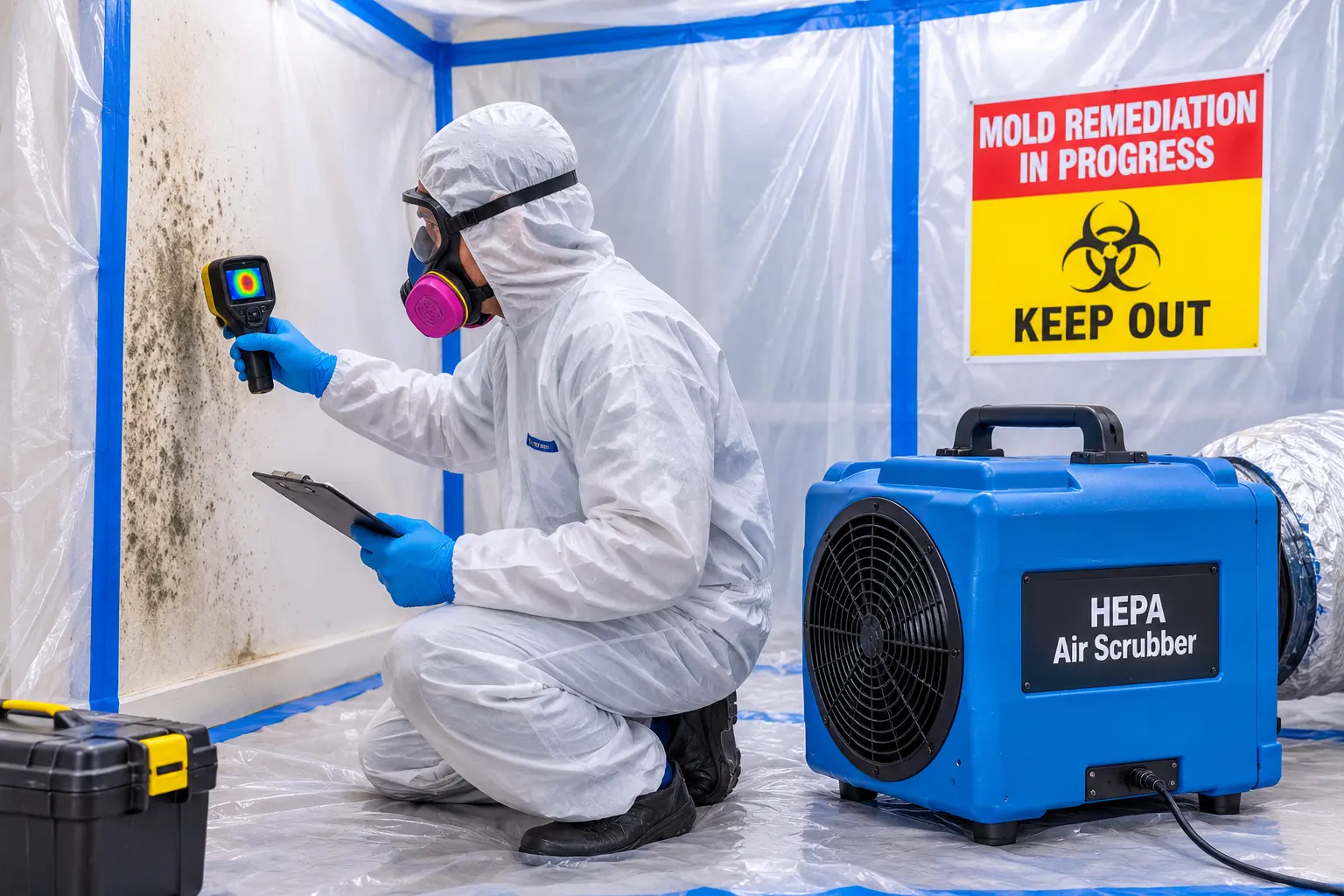
Most mold remediation cost topically $1,500 to $9,000, with a national average of about $3,500 . A small, contained patch can cost as little as $500. Whole-house remediation runs $10,000 to $30,000. New Jersey prices tend to sit at or above the national middle: one NJ cost estimate puts local work at $12 to $25 per square foot
Your price depends mostly on three things: how much area is affected, where it is, and whether the moisture behind it has to be fixed too. This guide breaks down cost by location, explains why remediation costs what it does, and gives you a checklist for judging any quote you get.
Mold Remediation vs. Mold Removal: What’s the Difference?
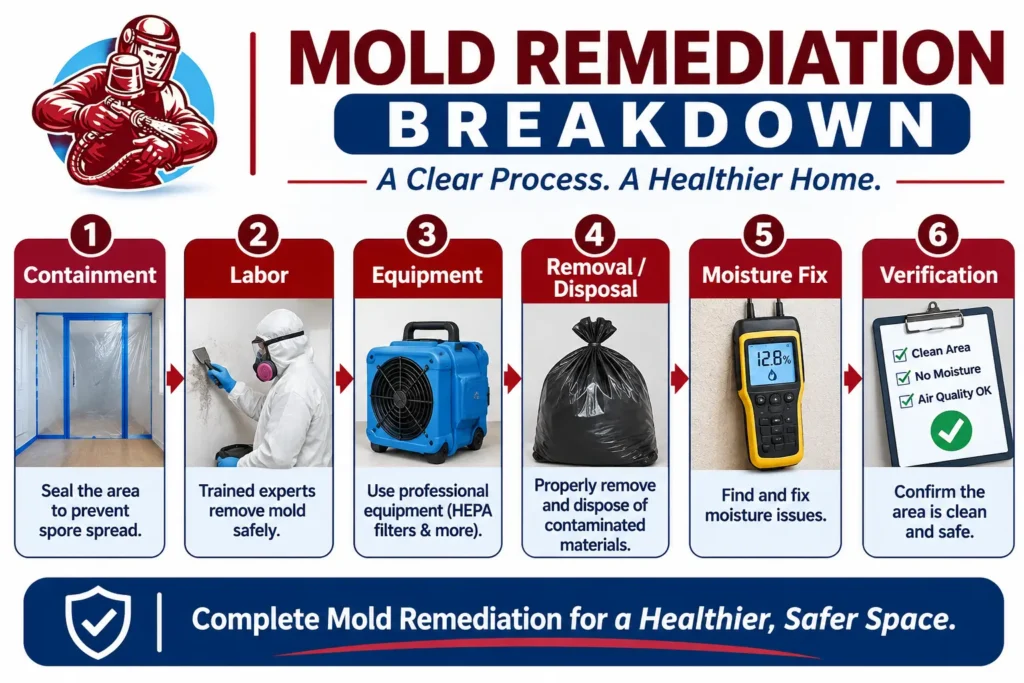
Mold removal means cleaning visible growth off surfaces. Mold remediation is the full job. It contains the area so spores don’t spread, removes or cleans contaminated materials, filters the air, fixes or flags the moisture source, and confirms the area is clean and dry. Removal alone is cheaper, but if the moisture source isn’t fixed, the mold usually comes back. When you compare prices, make sure both quotes describe the same scope.
Mold Remediation Cost by Location
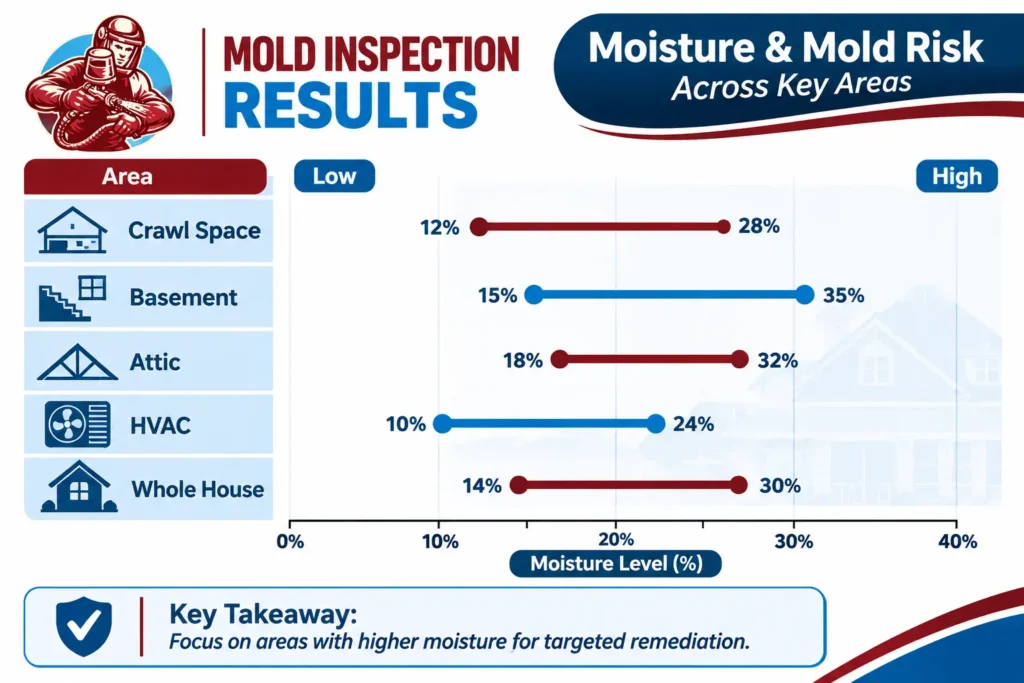
| Location | Typical cost |
| Small area (e.g., bathroom) | From $500 |
| Crawl space | $500 – $2,000 (Fixr); $1,000 – $6,000 for professional removal (HomeAdvisor) |
| Basement | $1,500 – $4,000 average |
| Attic | $1,500 – $9,000 (Fixr); most black mold attic jobs $1,000 – $4,000, severe $6,000 – $15,000 |
| HVAC system | $3,000 – $10,000 |
| Whole house | $10,000 – $30,000 |
Basement Mold Remediation Cost in NJ
Basements are a frequent source of mold in New Jersey homes, because they sit below grade and collect moisture. MMRG’s own pricing runs $1,000 to $3,000 for a problem confined to one or two walls, and over $6,000 for larger areas. The price climbs further if waterproofing is needed to stop the water. Full breakdown: Basement mold removal cost in NJ.
Attic Mold Removal Cost in NJ
Attic mold usually comes from poor ventilation, bathroom fans venting into the attic, or roof leaks. Costs rise when insulation has to be removed or roof sheathing treated or replaced. Full breakdown: Black mold attic removal cost in NJ.
Crawl Space Mold Remediation Cost
Crawl spaces are cheaper per job because they’re smaller, but access is slow and moisture control often adds a vapor barrier or encapsulation ($1,500 to $15,000 for full encapsulation, per HomeAdvisor). Full breakdown: Crawl space mold removal cost in NJ.
How Much Does Black Mold Removal Cost?
Black mold remediation runs about $2,000 to $10,000, compared with roughly $1,500 to $6,000 for common green mold . Fixr puts toxic or hard-to-remove types at $800 to $7,000 or more. The difference comes mostly from stricter containment and protective gear, not a different removal method. The EPA doesn’t single out black mold as more dangerous than other molds, and its guidance treats all mold growth the same way: remove it and fix the moisture.
Mold Remediation Cost Per Square Foot
Professional remediation typically costs $10 to $30 per square foot of affected area . NJ estimates run about $12 to $25 .
The key words are “affected area.” Take a 400-square-foot finished basement with mold on 60 square feet of wall:
- Priced on the affected area: 60 sq ft × 10–30 = $600 to $1,800
- Priced on the whole room: 400 sq ft × 10–30 = $4,000 to $12,000
A quote should tell you which area it’s measuring. Sometimes the whole room really does need work, for example when moisture readings show the drywall is wet all the way around. But you should be told why.
Why Is Mold Remediation So Expensive?
The visible scrubbing is a small part of the job. Most of the cost comes from:
- Containment: plastic barriers and negative air pressure so spores don’t spread to the rest of the house.
- Labor: typically $75 to $120 an hour for trained crews in protective gear (Fixr).
- Equipment: HEPA air scrubbers and vacuums add $500 to $1,000 (Fixr). Dry ice blasting costs more.
- Material removal and disposal: drywall, insulation and carpet that can’t be cleaned have to be cut out, bagged and replaced.
- The moisture fix: a plumbing repair, waterproofing or ventilation work, priced separately.
- Verification: confirming the area is clean and dry before walls are closed up.
Skipping any of these can make a quote cheaper, but it also raises the chance you’ll pay again when the mold returns.
Mold Testing and Inspection Costs in NJ
How much does mold testing cost in NJ? A standard inspection with air and surface sampling usually costs $300 to $1,000. The site visit alone runs $150 to $500, and each lab sample adds $75 to $350. A post-remediation clearance test usually costs $100 to $300. Full breakdown: Mold testing cost in NJ.
Is a mold inspection free? Sometimes. Many remediation companies, including MMRG, offer free inspections. MMRG openly treats its free inspection as the way it earns the job, and says it doesn’t add the inspection cost to its contracts. Independent testing companies usually charge, because testing is what they sell.
Should I test for mold before remediation? Usually not, if you can see it. The EPA says that “in most cases, if visible mold growth is present, sampling is unnecessary” (EPA). Testing is worth paying for when you suspect hidden mold, need documentation for a sale or insurance claim, or want to confirm a cleanup worked.
Does Homeowners Insurance Cover Mold Remediation in New Jersey?
Sometimes, depending on the cause. Homeowners policies generally cover mold that results from a sudden, accidental covered event, such as a burst pipe. They typically exclude mold from gradual problems like slow leaks, condensation or long-term humidity . Flood damage needs separate flood insurance. Some policies also cap mold coverage at a set dollar amount. Read your policy’s mold language, photograph the damage before work starts, and call your insurer before remediation if the cause was sudden.
Can You Remove Mold Yourself?
For small areas, yes. The EPA says most people can clean mold covering less than about 10 square feet themselves, using an N-95 respirator, gloves and goggles. Above that, or after significant water damage, or when mold is hidden in walls or HVAC, hire a professional. Two common DIY mistakes: painting over mold (it grows back underneath) and mixing bleach with ammonia-based cleaners (toxic fumes). Also remember that dead mold still has to be removed, because it can still trigger allergies.
Does New Jersey Require a License for Mold Remediation?
No. New Jersey doesn’t currently license mold remediators or inspectors. Bills to create certification through the Department of Community Affairs have been introduced repeatedly, including S574 in 2020 and S1030 in 2024, but none of the records we reviewed shows one passing. That leaves it to you to check a company’s credentials:
- National certifications (for example IICRC, ESA, EAA or IAQ credentials) and who holds them
- Proof of general liability insurance
- A written scope, not just a price
- A clear explanation of the moisture source and how it will be fixed
- Willingness to tell you when testing isn’t needed
How to Tell If a Mold Remediation Quote Is Fair
A fair quote is specific. Use this checklist:
- States the affected area in square feet, and how it was measured
- Names the moisture source and whether fixing it is included
- Describes containment (plastic barriers, negative air)
- Lists materials to be removed and whether replacement is included
- Includes HEPA vacuuming and air filtration
- Says how the work will be verified at the end
- Explains any testing it includes, and why
- Falls within the per-square-foot ranges above, or explains why not
Here’s an illustrative comparison. Quote A says “Mold remediation, basement: $7,500.” Quote B says “Contain 60 sq ft along the north wall; remove and dispose of the lower 2 feet of drywall and insulation; HEPA vacuum and air scrub; apply antimicrobial; seal the floor-wall crack causing seepage; moisture verification before closing: $2,400.” Quote B is easier to judge, because you know exactly what you’re buying. Quote A can’t be compared to anything.
If two quotes differ by thousands of dollars, ask each contractor to explain the difference in scope. A gap that size usually comes from a difference in what’s being removed or whether the moisture is being fixed.
Emergency Mold Remediation Service
Mold remediation itself is rarely a true emergency. Fresh water damage is. After a burst pipe, flood or sewage backup, the EPA advises discarding anything that has stayed wet for more than 24–48 hours, which is also when mold begins to take hold. Fast extraction and drying can keep a 500–3,000 water cleanup from turning into a remediation job several times that size. MMRG offers 24/7 emergency water extraction and handles the mold assessment afterward. If mold is already established, remediation should be scheduled promptly, especially if anyone in the home has asthma or allergies, but it rarely needs a middle-of-the-night crew.
Get an Accurate Price
The ranges above tell you what’s normal. Your actual price depends on what an inspection finds. MMRG Mold Remediation & Basement Waterproofing offers free inspections across New Jersey, with no inspection cost folded into the contract and no lab tests you don’t need. Inspections are led by Randy Cece, a Certified Mold Assessor (EAA) and Indoor Air Quality Technician (ESA) with documented training dating back to 2002. MMRG holds IAQ, ESA and IICRC certifications, gives you a written scope that names the moisture source, and backs its pricing with a 10% price-match guarantee.
Get a clear scope and a fair price. Schedule a free inspection through our Emergency mold remediation Service page or call 908-601-1307.
FAQ
How long does mold remediation take?
Typically one to three days for a contained area like one basement wall or a bathroom. Larger jobs that involve removing drywall, attic insulation or crawl space encapsulation can take a week or more. Drying time and any repair work come on top of that.
Will mold come back after remediation?
Not if the moisture source is fixed. Mold needs moisture to grow, so remediation that removes the growth but leaves the leak, seepage or humidity in place almost always fails. Keep indoor relative humidity below 60%, ideally 30–50% (EPA), and watch for returning musty smells.
Is mold remediation cheaper if I catch it early?
Usually, yes. Cost scales with affected area. A patch caught on one wall can be a few hundred to a few thousand dollars, while the same problem left for months can spread behind walls and under flooring into a much larger job.
Does a mold remediation company also fix the leak?
It depends on the company. Some only clean, and some handle the moisture source as well. MMRG does both remediation and basement waterproofing, so the water problem and the mold can be addressed in one scope. Ask any company whether its quote includes the moisture fix.
Do I need to leave my home during remediation?
Usually not for a small, contained job, since containment keeps the work area sealed. For large jobs, or when someone in the home has asthma, allergies or a weakened immune system, it may be safer to stay elsewhere until the work is done and verified.