
Attic mold in New Jersey homes is most commonly caused by poor ventilation, bathroom exhaust fans venting directly into the attic, roof leaks, and condensation buildup — and it can spread across your entire roof deck in a matter of weeks. NJ’s humid coastal climate, especially in Monmouth County communities like Rumson, Long Branch, and Middletown, creates year-round moisture conditions that make attics uniquely vulnerable. The good news is that once you understand the cause, attic mold can be stopped permanently — but only if it’s treated correctly and the moisture source is eliminated at the same time.
If you’ve climbed into your attic and noticed dark staining on the plywood, a musty odor on your upper floor, or unexplained black spots on your roof sheathing, you’re not alone. We receive calls every week from New Jersey homeowners across Holmdel, Tinton Falls, Edison, and Jersey City who have discovered attic mold that’s been silently spreading for months — sometimes years — without a single visible sign from inside the home.
This guide covers everything you need to know: what causes attic mold, how to identify it, what professional remediation involves, what it costs in NJ, and how to keep it from coming back. If you’re ready to get a professional opinion now, you can learn more about our attic mold removal services in New Jersey.
What Is Attic Mold — and Why Are NJ Homes So Vulnerable?
Attic mold is fungal growth that develops on wood surfaces inside your attic — most commonly on roof sheathing (the plywood or OSB panels attached to your rafters), but also on rafters, ridge boards, insulation, and collar ties. It thrives wherever wood stays damp and airflow is limited.
Mold spores are present in every home. The difference between a clean attic and a moldy one is simple: moisture and time. Give mold spores a consistently damp surface and temperatures above 40°F, and colonies can establish themselves in as little as 24 to 48 hours.
What Attic Mold Looks Like
Knowing what you’re looking for is the first step. Attic mold typically appears as:
- Black spots or streaks on roof sheathing — the most common presentation; often confused with dirt or aging wood
- Green or gray fuzzy patches on rafters or ridge boards
- White powdery growth — early-stage colonies, sometimes mistaken for mineral deposits or sawdust
- Dark staining that fans outward from a central point, often near a blocked vent or exhaust duct termination
Attic mold on plywood is especially common in New Jersey homes because plywood is porous and retains moisture longer than solid lumber. Once mold penetrates the surface fibers of plywood sheathing, surface treatment alone won’t eliminate it — mechanical removal is required.
Why New Jersey Homes Are Especially at Risk
New Jersey’s climate creates a perfect storm of attic mold conditions. Summers are hot and humid, with average relative humidity regularly exceeding 70% — the threshold at which mold colonies accelerate in growth. Winters bring cold temperatures that cause warm interior air to condense on cold attic surfaces. And coastal communities from Monmouth Beach to Deal and Oceanport contend with salt-laden sea air that increases moisture absorption in wood.
On top of that, New Jersey has a significant stock of older homes — many built in the 1950s through 1980s — with ventilation systems designed for a different era, and bathroom exhaust fans that were routinely ducted into attic spaces rather than directly outside. That combination of climate, age, and construction practice makes attic mold one of the most common home problems we deal with across the state.
The 7 Most Common Causes of Attic Mold in NJ Homes
1. Poor or Blocked Attic Ventilation
This is the single most common cause of attic mold we see in New Jersey — and it’s almost always fixable. A properly ventilated attic maintains continuous airflow from soffit vents at the eaves to ridge or gable vents at the peak, flushing warm, moist air out before it can condense on cold wood surfaces.
When ventilation fails — because soffit vents are buried under insulation, ridge vents are clogged with debris, or the ventilation system was never adequately designed — moisture gets trapped and mold follows. New Jersey building code (NJAC 5:23) requires a minimum of 1 square foot of net free ventilation area for every 150 square feet of attic floor space. Many older homes in Colts Neck, Holmdel, and Middletown were built before these standards were strictly enforced, and some have never been updated.
Signs your ventilation is failing:
- Your upper floors are unusually hot in summer
- Ice dams form along your roofline each winter
- The attic feels stuffy or humid even in cold weather
- You can see dark staining concentrated near the ridge or along exterior walls
2. Bathroom or Kitchen Exhaust Fans Venting Into the Attic
If I had to pick the single most preventable cause of attic mold we encounter in NJ homes, this would be it. Exhaust fans are designed to move warm, moisture-laden air out of your home entirely. When a contractor — or a well-meaning DIYer — terminates that duct inside the attic instead of routing it through to the exterior, every hot shower, every stovetop boil, every load of laundry dumps humid air directly onto cold attic surfaces.
We inspected a home in Tinton Falls where a single second-floor bathroom fan had been venting into the attic for approximately six years. By the time the homeowner noticed a musty smell in the upstairs hallway, black mold covered more than 400 square feet of roof sheathing — the entire north-facing roof deck. The remediation cost more than $7,000, plus $1,200 to properly reroute the exhaust duct to a roof cap. The original ducting error would have cost less than $200 to do correctly.
This is extremely common in older homes throughout Edison, Jersey City, Middletown, and Eatontown — communities with significant housing stock from the 1960s and 70s when this practice was standard.
3. Roof Leaks
A leaking roof introduces liquid water into your attic — the fastest path to mold growth. Missing or cracked shingles, failed flashing around chimneys and skylights, deteriorated pipe boots, and compromised ice-and-water shield along the eaves can all allow water to infiltrate the attic cavity.
The tricky thing about roof leak mold is that the visible water stain on your ceiling and the mold growth in your attic are often not directly above each other. Water travels along rafters and roof decking before it drips, which means a flashing failure at a chimney can cause mold on plywood ten feet away from where the water actually enters.
New Jersey’s nor’easters are a particularly frequent culprit. We routinely receive calls in late winter and spring from homeowners in Rumson, Monmouth Beach, and Long Branch whose roofs sustained storm damage they weren’t aware of until mold showed up weeks later.
Professional advice: If your home has experienced any roof leak, ice dam, or significant storm damage — even if the roof has since been repaired — schedule an attic inspection within 30 days. Mold doesn’t wait for a convenient time to grow.
4. Attic Condensation
Attic condensation mold is a subtler problem than a roof leak, but it’s just as damaging. It occurs when warm, humid air from your living space rises into the attic and contacts cold roof sheathing — the same physics that cause a cold glass to “sweat” on a warm day.
In New Jersey, this typically intensifies in late fall and early winter. As homeowners crank up the heat, warm air rises through ceiling light fixtures, plumbing chases, attic hatches, and partition top plates — any gap in the attic floor is an entry point. Once that warm air hits cold roof decking, it condenses and keeps the wood perpetually damp.
Older homes in Little Silver, Oceanport, and Colts Neck with minimal air sealing are particularly prone to this. Ice dam formation along the roofline is one of the clearest indicators that warm air is escaping into the attic — it signals that the attic floor is not adequately sealed or insulated.
5. Improperly Installed Insulation
Insulation errors are a surprisingly common contributor to attic mold in NJ homes. The two most frequent mistakes we see:
- Insulation blown directly over soffit vents, blocking the airflow intake that the entire ventilation system depends on. Without baffles or rafter vents to maintain an air channel, the soffit is essentially sealed shut.
- Kraft-faced insulation installed with the vapor barrier facing the wrong direction, trapping moisture in the wrong layer and holding it against wood surfaces.
Both errors are inexpensive to correct before they cause mold. After they’ve caused mold, the cost is considerably higher.
6. HVAC Equipment and Leaky Ductwork in the Attic
Homes with air handlers or duct systems routed through the attic — common in larger homes throughout Holmdel, Colts Neck, and parts of Middletown — face an additional moisture risk. Leaky duct connections release conditioned air (which can be very humid in summer) directly into the attic. Condensate drain lines from attic air handlers that are improperly routed or clogged can drip water onto the attic floor and insulation below. The result is localized but aggressive mold growth concentrated around HVAC equipment.
7. Whole-Home Moisture Problems
Attic mold is always a symptom of a moisture problem somewhere — and that problem isn’t always in the attic itself. Homes with wet basements, crawl spaces, or persistent indoor humidity issues can develop attic mold through the “stack effect”: air pressure differences that push ground-level moisture upward through the home and into the attic.
We see this frequently in Jersey City row homes, attached townhomes in Edison, and older colonial-style homes in Middletown where crawl spaces are unencapsulated. Treating the attic mold without addressing the source-level moisture is like mopping up a floor while the faucet is still running.
Signs of Attic Mold: What to Look and Listen For
You don’t need to climb into your attic to suspect you have a mold problem. Here are the most common signals:
Visual signs (inside the attic):
- Black, green, or gray spots or patches on roof sheathing, rafters, or plywood
- Dark staining that radiates from vents, exhaust terminations, or nail penetrations
- White powdery patches on wood surfaces (early-stage colonies)
- Wet or compressed insulation in any area of the attic floor
Non-visual signals (from inside your home):
- A musty or earthy smell on the second floor or in upstairs closets
- Peeling or bubbling paint on ceilings directly below the attic
- Family members experiencing unexplained respiratory symptoms, chronic coughing, or worsening asthma
- Higher-than-normal energy bills (poor attic conditions force your HVAC to work harder)
- Ice dams forming along your roofline in January and February
Attic Mold Health Risks You Shouldn’t Ignore
Attic mold is not just a structural problem — it’s a health concern. Mold spores migrate from the attic into living spaces through recessed light fixtures, attic hatches, and ceiling penetrations. Once airborne, they can trigger respiratory irritation, allergic reactions, eye and skin irritation, and persistent sinus problems.
Children, elderly family members, and anyone with asthma, allergies, or a compromised immune system are particularly vulnerable. If members of your household are experiencing unexplained symptoms that improve when they leave home, that’s a strong indicator that your indoor air quality may be affected by attic mold.
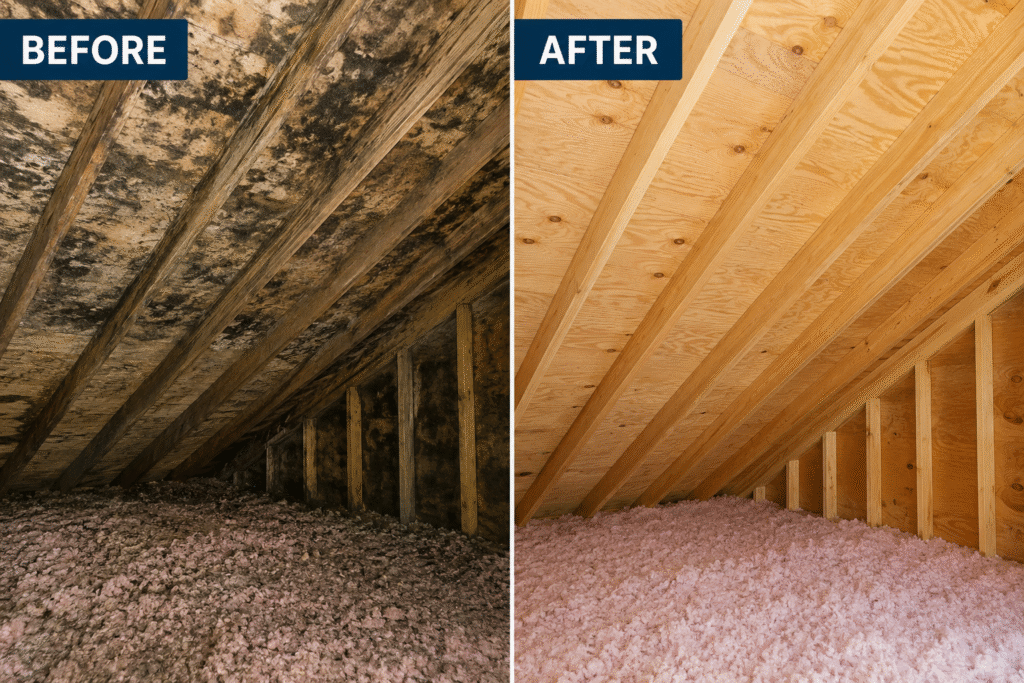
Attic Mold Treatment: What Professional Remediation Involves
Can You Remove Attic Mold Yourself?
The short answer: for small, isolated surface mold on non-porous materials, limited DIY treatment is possible with proper protective equipment and EPA-registered fungicide. For any mold on wood sheathing, rafters, or plywood — which is essentially every attic mold situation we encounter in NJ — professional remediation is strongly recommended.
Here’s why DIY almost always falls short:
- Bleach does not kill mold on porous wood surfaces. It removes the color but leaves the mold’s root structure (mycelium) alive and intact. The mold will return within weeks.
- Without containment, you spread spores. Disturbing mold colonies without professional-grade HEPA containment and negative air pressure systems releases billions of spores into your living space.
- Without fixing the source, mold comes back. The most common call we receive from homeowners who attempted DIY treatment is “the mold came back even worse.” This happens when the moisture source — the ventilation problem, the rerouted fan, the roof leak — is never addressed.
The Professional Attic Mold Remediation Process
When our certified team arrives at a home in Monmouth County or elsewhere in New Jersey, here’s what the process looks like:
- Inspection and moisture testing — We use moisture meters and thermal imaging to identify the full scope of the mold and locate the moisture source driving it.
- Containment setup — We establish negative air pressure within the attic using commercial air scrubbers and poly barriers to prevent cross-contamination to living spaces.
- HEPA vacuuming — All loose mold spores are vacuumed from surfaces before any physical treatment begins.
- Mechanical removal — Mold is physically removed from wood surfaces using dry ice blasting, soda blasting, or hand scrubbing with wire brushes, depending on the severity and surface type.
- Antimicrobial treatment — All treated surfaces are coated with an EPA-registered antimicrobial solution to kill remaining spores and inhibit regrowth.
- Encapsulation — A mold-resistant encapsulant is applied to seal the treated wood and provide a lasting protective barrier.
- Source correction — We repair or coordinate repair of the moisture source: rerouting exhaust fans, adding ventilation, addressing roof leaks.
- Post-remediation clearance testing — An independent third-party air quality firm conducts air sampling to confirm the attic meets clearance standards before we close the project.
- Documentation — We provide a full written report, suitable for insurance claims and real estate transactions, documenting the work performed and the clearance results.
How Much Does Attic Mold Removal Cost in NJ?
Attic mold removal in New Jersey typically costs between $1,500 and $6,000 for most residential projects. Larger attics with extensive contamination or structural repairs required can reach $8,000 to $15,000 or more.
Here’s a general breakdown by project scope:
| Project Scope | Typical Cost Range |
| Small isolated spot (under 10 sq. ft.) | $500 – $1,500 |
| Moderate coverage (10–100 sq. ft.) | $1,500 – $4,000 |
| Extensive coverage (100–500 sq. ft.) | $4,000 – $8,000 |
| Full attic remediation (500+ sq. ft.) | $8,000 – $15,000+ |
| Roof deck board replacement (if needed) | Add $3,000 – $10,000 |
| Ventilation repair / exhaust fan rerouting | Add $500 – $2,500 |
| Post-remediation clearance air testing | $300 – $500 |
Does Homeowner’s Insurance Cover Attic Mold in NJ?
It depends on the cause. Insurance companies in New Jersey generally cover mold remediation when it results directly from a sudden covered event — a burst pipe, sudden roof failure from storm damage, or wind-driven rain intrusion. Mold that developed from long-term condensation, inadequate ventilation, or deferred maintenance is typically excluded.
Our team provides thorough written documentation, moisture data, and photographs that NJ insurance adjusters recognize and accept. If you believe your attic mold resulted from a covered event, we’ll help you build the strongest possible claim.
How to Prevent Attic Mold Permanently
Treating attic mold without addressing the cause is temporary. Here’s how to stop attic mold from ever returning — or from starting in the first place.
1. Get Your Ventilation Right
A balanced ventilation system — soffit intake vents at the eaves plus ridge or gable exhaust vents at the peak — creates continuous airflow through the attic that keeps moisture moving out. Verify that soffit vents are not buried under insulation by checking for daylight through them from inside the attic. Install rafter baffles if needed to maintain that air channel.
2. Reroute All Exhaust Fans to the Exterior
Walk your attic and trace every exhaust duct. Any duct that terminates inside the attic — regardless of what room it serves — must be rerouted to exit through a roof cap or soffit vent. Use insulated flex duct to prevent condensation inside the duct run. This single correction eliminates one of the top causes of attic mold we see across New Jersey.
3. Air-Seal the Attic Floor
Spray foam or caulk every penetration in the attic floor: recessed lights, plumbing stacks, wire chases, partition top plates, attic access hatches. Stopping warm air at the source is more effective — and less expensive — than trying to ventilate it out after it arrives.
4. Maintain Your Roof
Schedule an annual roof inspection, particularly after New Jersey’s harsh winters and nor’easters. Keep gutters clean and free-flowing to prevent ice dam formation along the eaves. Replace cracked or missing flashing immediately — especially around chimneys, skylights, and pipe boots.
5. Control Indoor Humidity
Keep your home’s relative humidity below 50% year-round. Run bathroom exhaust fans during every shower and for at least 15 minutes after. Consider a whole-home dehumidifier if your basement or crawl space consistently runs humid — that moisture will work its way upward.
Annual Attic Check Checklist for NJ Homeowners
Run through this every spring and after any major storm:
- Are soffit vents visible and unblocked from inside the attic?
- Is there any daylight visible through roof sheathing?
- Do you see dark spots or staining on plywood or rafters?
- Do all exhaust ducts terminate outside the home?
- Is insulation dry and undamaged throughout the attic floor?
- Do you detect any musty or earthy odors in the attic space?
- Has your roof been inspected within the past 12 months?
Attic Mold Across New Jersey: Local Conditions and Risk Areas
Attic mold is a statewide problem in NJ, but certain communities face heightened risk due to a combination of housing age, construction style, and geographic moisture conditions.
Monmouth County is one of the highest-risk regions for attic mold in New Jersey. The county’s proximity to the Atlantic Ocean and Raritan Bay means persistent coastal humidity, salt-laden air, and frequent wind-driven rain events that challenge attic systems year-round. Communities including Rumson, Monmouth Beach, Little Silver, and Deal see mold develop particularly fast because elevated ambient humidity accelerates moisture absorption in roof sheathing.
In Holmdel and Colts Neck, larger homes with complex rooflines, multiple dormers, and cathedral ceiling sections create attic geometries that are difficult to ventilate adequately. We frequently work in these towns on homes where renovations added insulation without a corresponding adjustment to the ventilation system — a common trigger for new mold growth within one to two years of a well-meaning upgrade.
Middletown and Tinton Falls have high concentrations of split-level and bi-level homes from the 1960s and 1970s — an era when bathroom fans venting into attics was the accepted standard. Many of these homes still have the original ductwork configuration. If you own a home from this era in either town and have never had the exhaust fans inspected, there is a meaningful probability that at least one is venting into your attic.
In Eatontown and Oceanport, older military-era housing stock combined with proximity to the Shrewsbury River creates a persistent ambient humidity challenge. These homes often have minimal soffit ventilation and benefit significantly from professional ventilation assessment.
Long Branch (07740) presents unique challenges because of its mix of coastal single-family homes and multi-family properties. Rental properties, in particular, tend to go years without attic inspections — and by the time mold is discovered, it’s typically advanced to the level of full attic remediation.
Edison and Jersey City are inland by comparison but no less affected. Edison’s large number of cape-cod and split-level homes have finished or partially finished attic spaces that are notoriously difficult to ventilate. Jersey City’s attached row homes and townhouses share roof systems and party walls that can complicate both moisture diagnosis and remediation scope.
Wherever you live in New Jersey, if your home was built before 1990 and has never had a professional attic inspection, you’re operating with incomplete information about one of the most moisture-vulnerable parts of your home.
When to Call a Professional Attic Mold Remediation Company in NJ
Not every attic problem requires a call — but these situations do. Contact a certified attic mold remediation professional in New Jersey if:
- You see dark staining or spotting on roof sheathing, rafters, or plywood covering more than 10 square feet
- You or a family member notices a persistent musty smell on the second floor or in upstairs rooms
- You’ve had a roof leak, ice dam damage, or storm intrusion event in the past 12 months
- You’re listing your home for sale or completing a pre-purchase inspection and the attic has not been assessed
- You’ve attempted DIY mold treatment and the mold returned
- A family member is experiencing unexplained respiratory symptoms, especially ones that improve when they leave home
Why DIY is rarely the right call for attic mold: Attic mold on wood sheathing requires mechanical removal — not just chemical treatment. Without professional containment, you risk spreading spores to your living areas. And without addressing the underlying moisture source, the mold will return. A professional remediation company provides something DIY cannot: a written, documented clearance confirmation that the problem is solved.
Why Choose My Mold Removal Guys for Attic Mold Removal in NJ
We’re a New Jersey-based water damage and mold remediation company that has worked in attics across Monmouth County, Middlesex County, Hudson County, and communities throughout the state. Here’s what separates our approach:
We fix the source, not just the symptom. Every project we complete includes a root-cause moisture analysis and source correction. We don’t hand you a remediated attic and leave the ventilation problem in place.
We’re certified and licensed in New Jersey. Our team holds IICRC (Institute of Inspection Cleaning and Restoration Certification) credentials in mold remediation, and we carry full liability insurance and NJ contractor licensing.
We support your insurance claim. We provide complete written documentation — moisture readings, photo evidence, scope of work, clearance test results — in formats accepted by New Jersey insurance adjusters. If your mold resulted from a covered event, we’ll help you build the case.
We coordinate independent clearance testing. We don’t sign off on our own work. Post-remediation air quality testing is conducted by a third-party environmental lab — because that’s what actually protects you.
We serve all of New Jersey, with particular depth of experience in Monmouth County communities: Holmdel, Deal, Eatontown, Oceanport, Rumson, Colts Neck, Tinton Falls, Little Silver, Middletown, Monmouth Beach, Long Branch — and statewide including Edison and Jersey City.
Get a Professional Attic Mold Inspection in NJ
Attic mold is not a problem that resolves on its own. Left untreated, it spreads, it deepens into wood fibers, it affects your home’s air quality, and it can compromise the structural integrity of your roof deck. The sooner it’s addressed, the smaller — and less expensive — the project.
If you’ve spotted black spots on your roof sheathing, noticed a musty smell in your home, or simply haven’t had your attic inspected in years, don’t wait for the problem to find you.
→ Learn about our Attic Mold Removal Services in NJ and schedule your professional inspection today.
Our team is available across New Jersey — including all of Monmouth County, Edison, Jersey City, and surrounding communities. We provide detailed, no-pressure assessments and honest recommendations, whether the scope of work is large or small.
Frequently Asked Questions About Attic Mold in New Jersey
Q1: What is the most common cause of attic mold in NJ homes?
The most common cause is poor or blocked attic ventilation, often combined with bathroom exhaust fans that vent into the attic rather than outside.
Q2: How do I know if I have attic mold without going into the attic?
Signs include a persistent musty smell on your upper floor, peeling ceiling paint, worsening indoor allergies, ice dams in winter, and unexplained increases in energy bills.
Q3: Is attic mold on plywood dangerous to my home’s structure?
Yes — mold degrades wood fibers over time and can compromise the structural integrity of roof sheathing and rafters if left untreated for years.
Q4: How much does attic mold removal cost in New Jersey?
Most NJ attic mold remediation projects cost between $1,500 and $6,000, depending on attic size, mold coverage, and whether structural repairs or ventilation corrections are needed.
Q5: Can attic mold spread to the rest of my house?
Yes — mold spores travel through ceiling penetrations, recessed lights, and attic access hatches into living spaces, affecting indoor air quality throughout the home.
Q6: Will attic mold come back after it’s been treated?
Mold will return if the underlying moisture source — poor ventilation, an improperly routed exhaust fan, or a roof leak — is not corrected as part of the remediation process.
Q7: Does homeowner’s insurance cover attic mold remediation in NJ?
Coverage depends on the cause: mold resulting from a sudden covered event like storm damage may be covered, while mold from long-term ventilation issues or deferred maintenance is typically excluded.