
| QUICK ANSWER: Attic mold in New Jersey homes is caused by moisture, and in the large majority of attics we inspect, that moisture is condensation — not a roof leak. Warm, humid air escapes your living space, rises into a cold attic, and condenses on the underside of the roof sheathing, where mold begins to grow. The permanent fix is not cleaning the wood; it is correcting the ventilation and sealing the air leaks that carry moisture upward in the first place. |
That distinction matters more than almost anything else you will read on this page. Homeowners across Monmouth County call us every winter convinced their roof is leaking. They have seen the dark staining across the plywood, and a leak is the explanation that makes intuitive sense. But when our inspectors get up there with a moisture meter, the roof is usually sound. The water was never coming in from outside. It was coming up from inside the house.
This guide explains what actually causes attic mold in New Jersey, how to recognise it, what removal involves, what it costs, and — most importantly — how to stop it coming back. It is written from what we find in real attics in Holmdel, Middletown, Long Branch, Rumson and the rest of the towns we serve, not from a national template.
Why New Jersey Attics Are Especially Prone to Mold
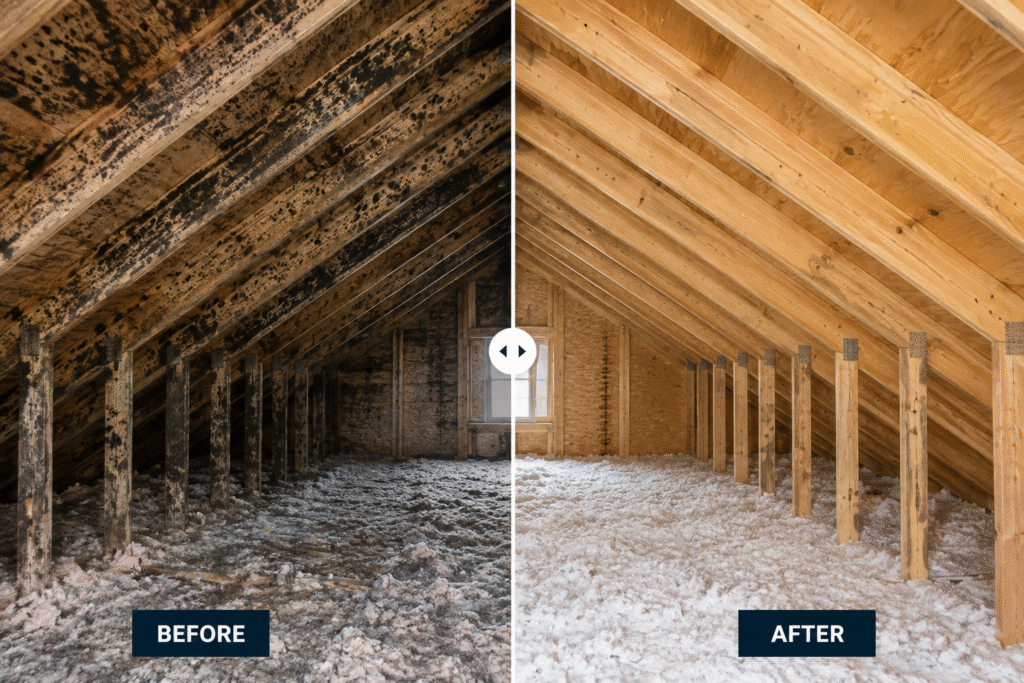
New Jersey Sits in the Worst Climate Zone for Condensation
Most of New Jersey — including all of Monmouth County — falls within IECC Climate Zone 4A, classified as mixed-humid. The northwestern counties sit in Zone 5A. Zone 4A is genuinely the difficult case for attics. Our winters get cold enough to chill roof sheathing below the dew point of the air touching it, and our summers are humid enough to keep the whole building loaded with moisture. A consistently dry-cold climate does not produce this problem. Neither does a warm-humid one. The combination does.
The practical consequence is that a typical New Jersey attic runs a condensation cycle from roughly October through March, every single year, whether or not anyone opens the hatch to look. That is six months of moisture forming on cold wood annually. Mold does not need a dramatic event to establish. It only needs that cycle to repeat.
Coastal Humidity Along the Monmouth County Shore
Homes in Monmouth Beach, Long Branch, Deal, Atlantic Highlands, Belford, Union Beach and Seaside Heights deal with elevated ambient humidity year round, simply because of proximity to the Atlantic and Sandy Hook Bay. There is a second, quieter problem in these towns that almost nobody anticipates: salt air corrodes vent hardware. Aluminium soffit screens, gable louvres and ridge vent baffles gradually clog and corrode, and the attic’s net free ventilation area shrinks year after year without anyone touching anything.
We have opened up shore-area attics where the homeowner was certain the roof was failing, and found soffit vents that had effectively sealed themselves shut with corrosion and salt deposit. The roof was fine. The attic simply had no way to breathe.
Old Roofs, New Insulation, and No Ventilation Upgrade
A large share of the housing stock across Middletown, Eatontown, Oceanport, Little Silver and Tinton Falls predates modern attic ventilation requirements. That alone is manageable. The problem arises from a well-intentioned upgrade.
Here is the pattern, and it is one of the most common causes of attic mold we encounter in New Jersey. A homeowner adds blown-in insulation to reduce heating costs. The installer blows it right out to the eaves. Without baffles holding it back, that insulation buries the soffit vents. Intake airflow drops to nearly zero. The attic can no longer dry itself. Two or three winters later, black staining appears across the sheathing and the homeowner has no idea why.
| EXPERT TIP: The irony is worth stating plainly: an energy-efficiency improvement, done without ventilation baffles, is one of the leading causes of attic mold in New Jersey homes. If you added insulation in the last decade and nobody mentioned baffles, your attic is worth checking. |
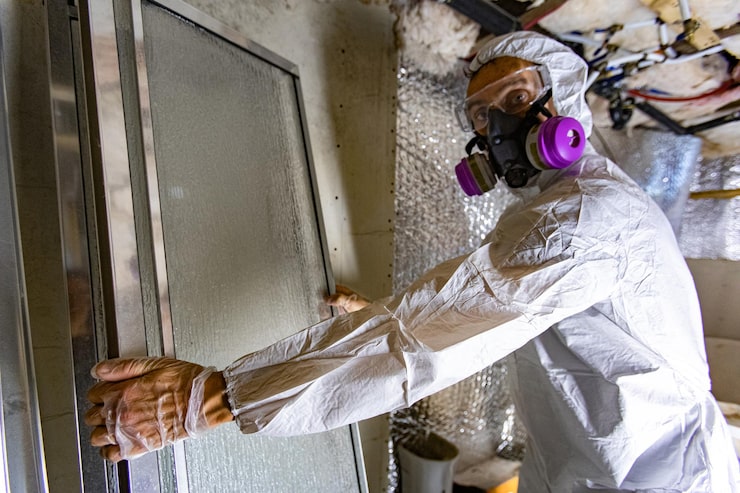
What Causes Attic Mold? The Five Real Causes, Ranked by How Often We Find Them
1. Attic Mold from Condensation — The Cause Behind Most NJ Cases
Attic condensation mold forms through a four-step cycle that repeats all winter:
1. Warm, moisture-laden air is generated inside your home — showers, cooking, laundry, dishwashers, houseplants, and simply the people living there breathing.
2. That air rises and escapes through gaps in your ceiling into the attic.
3. It meets the underside of the roof sheathing, which in a New Jersey January sits well below the dew point of that air.
4. The moisture condenses onto the wood. Once the wood’s moisture content reaches roughly 20 percent, mold has everything it needs to grow.
That 20 percent figure is a useful benchmark to remember. Below it, wood generally will not support mold growth. Above it, growth becomes a question of time rather than possibility. It is also why our inspectors take meter readings in the actual framing rather than making a visual judgment — the number tells you whether you are looking at an active problem or historic staining.
How to Recognise Condensation Mold: Look for the Striping
Condensation mold has a signature appearance. Because moisture forms on the sheathing and then runs downhill, growth develops in vertical streaks running between the rafters and along the nail lines. It almost always appears worst on the north-facing slope of the roof, which stays coldest longest and receives the least solar drying.
Mold from a roof leak looks entirely different — a concentrated patch clustered around one entry point. In practice, the pattern usually identifies the cause before any testing is done.
2. Attic Mold Ventilation Problems — What NJ Code Actually Requires
The International Residential Code, which New Jersey’s Uniform Construction Code adopts, sets a minimum in Section R806.2: net free ventilating area of at least 1/150 of the vented attic area. A reduced ratio of 1/300 is permitted only when 40 to 50 percent of the required ventilation sits in the upper portion of the attic — within three feet of the ridge — with the balance in the lower third.
In plain numbers: a 1,500 square foot attic requires roughly 10 square feet of net free ventilating area under the 1/150 standard. That is a lot more opening than most homeowners imagine.
| EXPERT TIP: Pay attention to the phrase net free area. It is not the physical size of the vent. A vent fitted with insect screen and louvres delivers considerably less airflow than its opening suggests — often less than half. Two attics with identical-looking vents can have very different real ventilation. |
The Four Ventilation Defects We Find Most Often
• Insulation pushed into the eaves with no baffles, blocking soffit intake entirely.
• Soffit screens painted over during exterior work, or corroded shut in shore towns.
• A ridge vent installed during a re-roof while the soffit intake was never opened. Exhaust with no intake moves almost no air — this is extremely common and homeowners assume the new ridge vent solved everything.
• Mixed exhaust types, such as a powered gable fan working against a ridge vent. The fan pulls air in through the ridge rather than up from the soffits, short-circuiting the airflow and leaving the attic corners dead.
3. Bathroom Fan Venting Into the Attic
A bathroom fan that discharges into the attic instead of through the roof or gable wall is depositing shower moisture directly onto cold sheathing. It is a code violation, and it is startlingly common in New Jersey homes — particularly where a bathroom was renovated by a general contractor who was not thinking about the attic above.
There is a close variant worth knowing about: a fan duct that terminates at a soffit vent. That looks correct from the ground, but the moist exhaust is drawn straight back into the attic through the intake it was just discharged beside. Dryer vents and kitchen exhaust fans terminating in the attic cause the same problem.
Five-Minute Check: Is Your Bathroom Fan Venting Correctly?
1. Turn the bathroom fan on and leave it running.
2. Go into the attic with a flashlight and locate the flexible duct leading from that fan.
3. Follow it. Does it terminate at a roof cap or gable louvre — or does it simply end somewhere in the insulation?
4. Feel around the duct joints for warm, moist air escaping where sections have separated.
5. Check whether the duct is insulated. An uninsulated duct condenses internally in winter and drips onto whatever is below it.
6. Confirm the exterior damper opens freely and has not been painted or corroded shut.
4. Attic Mold from a Roof Leak
Roof leaks cause less attic mold than homeowners assume, but they act faster. Wet wood combined with attic temperatures can establish growth within 24 to 72 hours. The usual entry points are chimney and skylight flashing, plumbing vent boots that have cracked with age, roof valleys, ice dams at the eaves, and popped nails.
The genuinely frustrating part is that a slow leak often never produces a ceiling stain downstairs. It soaks the insulation, wicks into the truss or rafter, and stays hidden for months. By the time anything becomes visible from inside the house, growth has spread well beyond the entry point.
| EXPERT TIP: Professional advice worth acting on: if you had a roof leak repaired this year and nobody went into the attic afterwards to check the sheathing and insulation, the mold may still be up there. Your roofer fixed the roof. Assessing what the water did before it was stopped is a different job, and it is not one roofers are asked to do. |
Attic Mold Roof Leak or Condensation? A Side-by-Side Comparison
| What to Check | Condensation Mold | Roof Leak Mold |
| Pattern | Vertical striping between rafters, spread widely | Concentrated patch in one area |
| Location | Worst on the north slope, fairly uniform | Directly below a flashing, boot or valley |
| Timing | Worsens through the winter months | Appears or worsens after heavy rain |
| Insulation | Damp across a broad area | Saturated in one specific spot |
| Sheathing condition | Surface growth, wood still sound | May be soft, delaminated or rotted |
5. Air Leakage from the Living Space Below
This is the cause almost nobody considers, and it is why ventilation alone rarely solves the problem permanently. Warm air rises and exits the top of a house, drawing replacement air in at the bottom — the stack effect. Every gap in your ceiling plane is part of that pathway, and every cubic foot of household air that travels through it carries moisture into the attic.
The leak paths we seal most often are recessed light housings, the attic hatch or pull-down stairs, plumbing vent stacks, wiring and duct penetrations, gaps at the top plates of interior walls, and chimney chases. Individually each seems trivial. Added together in an average home, they represent a substantial opening.
Signs of Attic Mold Every New Jersey Homeowner Should Know
Attic Mold on Plywood and OSB Sheathing
On plywood, attic mold typically appears as dark grey or black surface growth, often with visible texture. On OSB, it frequently shows first as darkening along the edges of the wood strands before spreading across the face.
Here is a point that reassures most homeowners once we explain it: surface mold on sheathing is generally not a structural problem in its early stages. It is growing on the wood, not consuming it. Structural damage comes from wood decay fungi, which is a different and considerably more serious organism. If your sheathing is discoloured but still firm when pressed, you are almost certainly dealing with surface mold, not rot.
Attic Mold Black Spots on Roof Sheathing — Is It Actually Mold?
Not every dark mark on roof sheathing is mold. Four things get mistaken for it regularly:
• Soot or creosote staining, usually found near a chimney chase.
• Historic water staining — flat, dry, stable, and without texture. It marks where a problem used to be.
• Blue stain fungus, which was present in the lumber before it was ever installed and causes no ongoing harm.
• Wood decay fungi, which is more serious than mold and requires structural assessment rather than remediation.
A practical field test: mold has texture and usually some colour variation across the growth. A stain is flat and uniform. If you brush it lightly with a gloved finger and material lifts, it is biological growth. If nothing lifts and the surface is smooth, it is likely a stain.
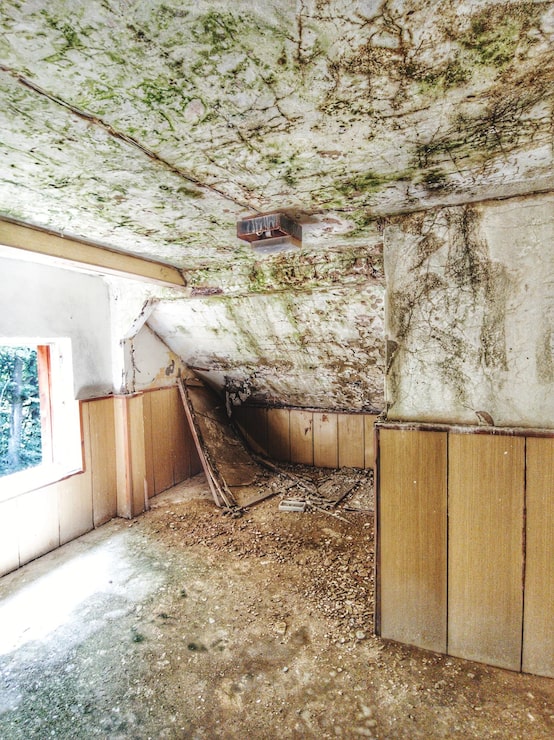
Signs You Will Notice From Inside the House
• A musty smell in upstairs rooms or closets, strongest near the attic hatch.
• Allergy or asthma symptoms that improve when someone leaves the house and return within hours of coming home.
• Frost forming on nail tips or sheathing, visible on a cold winter morning. This is the single clearest early warning of a condensation problem.
• Peeling paint or staining on upstairs ceilings.
• Unexpectedly high summer cooling bills, caused by damp insulation losing its R-value.
The 10-Minute DIY Attic Check
1. Pick a cold morning — condensation problems are visible in winter and invisible in July.
2. Bring a bright flashlight and wear an N95 respirator.
3. Examine the north-facing roof slope first. If there is a problem, it usually starts there.
4. Look along the nail lines and between the rafters for vertical streaking.
5. Check nail tips for frost or beaded moisture.
6. Verify the soffit vents at the eaves are clear and not buried in insulation.
7. Locate and trace every exhaust duct to confirm where it terminates.
8. Check whether the insulation is matted, sagging or discoloured.
9. Photograph anything questionable rather than disturbing it.
10. Come down and do not attempt to clean anything yet.
| SAFETY WARNING: Never walk between the joists — attic floors are frequently just drywall and you will come through the ceiling. Always wear an N95 or better before entering, and do not disturb suspected mold growth without proper containment, because doing so distributes spores through the house below. If you have asthma, a respiratory condition, or a compromised immune system, do not enter the attic at all. Send someone else or call a professional. |
Attic Mold Health Risks: What the Evidence Actually Supports
We want to be accurate here rather than alarming, because a great deal of what circulates online about mold and health is overstated.
Health effects that are well documented include nasal and sinus congestion, throat irritation, coughing, wheezing, eye irritation, and the worsening of existing asthma. The people most affected are those with asthma or allergies, immunocompromised individuals, infants, and older adults. The CDC and EPA both publish guidance on this, and both are worth reading directly rather than relying on contractor websites — including ours.
What we will push back on is the idea that attic mold is harmless because it is not in your living space. That is not accurate. The stack effect that carries moisture upward also means attic air circulates back into the rooms below. “It’s only in the attic” is the most common misconception we encounter, and it is the reason attic mold gets ignored for years.
How to Get Rid of Attic Mold: The Professional Process
Proper attic mold remediation follows a defined order. The sequence matters as much as the individual steps.
1. Inspection and moisture mapping. Meter readings taken in the actual sheathing and framing, plus assessment of the ventilation system against code requirements.
2. Identify and correct the moisture source. This is non-negotiable and it comes before remediation, not after.
3. Set up containment and negative air pressure so spores are not distributed into the living space during the work.
4. Remove the growth using appropriate attic mold treatment methods, then apply an antimicrobial.
5. Remove and replace contaminated insulation. Fibreglass and cellulose are porous throughout, so contaminated insulation cannot be treated — it has to go.
6. Correct the ventilation and air-seal the ceiling plane. Insulation removal is the ideal moment for this, because the attic floor is finally accessible.
7. Verify the result, with post-remediation testing where the situation warrants it.
| EXPERT TIP: Step 2 is where most failed remediations go wrong. Cleaning an attic before correcting ventilation, air leakage or an active roof leak guarantees the mold returns. Any company that quotes you for cleaning without discussing why the mold grew is selling you the same job twice. |
Attic Mold Treatment Methods Compared
| Method | How It Works | Our View |
| HEPA vacuum + antimicrobial | Physical removal followed by treatment | Our standard approach for most attics — thorough and controllable |
| Soda or media blasting | Abrasive removal of the affected surface layer | Effective on heavy growth, but demands full containment and careful cleanup |
| Dry ice blasting | CO2 pellets sublimate on impact, lifting growth | Fast and impressive to watch, but it does nothing about the cause. We do not use it as a substitute for correcting moisture |
| Encapsulation / sealer | A coating applied over treated wood | Legitimate only as a final step after removal and moisture correction — never as the entire job |
Five Red Flags in an Attic Mold Quote
• A price quoted over the phone without anyone inspecting the attic.
• A proposal recommending encapsulation with no mention of ventilation or air sealing.
• “Mold-killing” fogging offered as a standalone service.
• The same company performing both the testing and the remediation, with no independent laboratory involved.
• Pressure to sign on the first visit, or a discount that expires that day.
Attic Mold Removal Cost in NJ: What Actually Drives the Price
Attic mold removal cost in NJ varies more than most services, because two attics of the same square footage can require very different work. Six factors set the price:
1. The square footage of affected sheathing.
2. The severity of growth, and whether it has penetrated the wood surface or remains superficial.
3. Access. A walk-up staircase and full standing height is a completely different job from a small hatch with three feet of clearance, and labour reflects that.
4. Whether contaminated insulation must be removed and replaced.
5. How much ventilation correction and air sealing the attic needs.
6. Whether pre- and post-remediation testing is included in the scope.
The Real Cost Is Doing It Twice
The cheapest attic mold quote you receive is frequently the one that only addresses the growth. It will look like a saving. Then the same condensation cycle runs the following winter, the striping returns across the same north-facing slope, and you pay again — this time for remediation plus the ventilation work that should have been included originally.
When you compare quotes, the question that matters is not what it costs to clean the attic. It is what it costs to make sure you never have to clean it again.
Does Homeowners Insurance Cover Attic Mold in New Jersey?
It depends on the source of the moisture. Damage arising from a sudden, covered event — a burst pipe or storm damage to the roof — is more likely to be covered. Damage from long-term condensation or deferred maintenance is typically excluded as a maintenance issue. Read your specific policy language, and speak to your carrier before assuming either way. We can provide documentation to support a claim, but we cannot promise a particular outcome and you should be sceptical of any contractor who does.
How to Prevent Attic Mold and Stop It Permanently
The Permanent Fix Formula: Seal, Then Ventilate, Then Insulate
The order is what makes this work, and getting it wrong is why so many attics get “fixed” more than once.
1. SEAL first. Air-seal every penetration through the ceiling plane: recessed lights, the attic hatch, plumbing stacks, wiring holes, top plate gaps, chimney chases. This stops moisture reaching the attic at all.
2. VENTILATE second. Clear the soffit intake, install baffles to keep insulation out of the eaves, balance intake against exhaust, and avoid mixing exhaust types.
3. INSULATE last, to current code levels, kept well clear of the soffits.
Ventilating without sealing simply pulls more conditioned air out of your house. Insulating without baffles blocks the intake you just cleared. Sequence matters.
Seasonal Attic Maintenance for New Jersey Homeowners
• FALL (September–October): Inspect before the heat comes on. Clear soffits, check bath fan ducting and exterior dampers, confirm insulation is pulled back from the eaves.
• WINTER (January–February): Check for frost on nail tips on a cold morning. This is the best early warning signal available to a homeowner, and it costs nothing.
• SPRING (April–May): Inspect after the freeze-thaw season for leak evidence around flashing, boots and valleys.
• SUMMER (July–August): Confirm ridge and gable vents are unobstructed and that the attic is not running excessively hot.
Common Mistakes That Make Attic Mold Worse
• Adding insulation without installing baffles — the single most common self-inflicted cause we see.
• Installing a powered attic fan to “fix” humidity. It often depressurises the attic and pulls more conditioned, moisture-laden air up from the house.
• Sealing soffit vents to stop wind-driven rain or snow intrusion.
• Using bleach on sheathing. Bleach is mostly water; on porous wood the chlorine stays on the surface while the water soaks in and feeds the growth underneath.
• Painting over growth with ordinary primer instead of remediating it.
Attic Mold Across Monmouth County and Nearby New Jersey Towns
Attic mold behaves differently depending on where in New Jersey you live, because the building stock and the conditions differ. Here is what we typically find across our service area.
Shore Communities: Monmouth Beach, Long Branch, Deal, Atlantic Highlands, Belford, Union Beach and Seaside Heights
These towns share elevated year-round humidity and the salt-air corrosion problem described earlier. There is an additional risk specific to the shore: a high proportion of seasonal properties that sit closed and unconditioned from October through May. No air movement, no dehumidification, and coastal moisture working on the building for seven months is close to ideal mold conditions. If you close a property for the season, the attic deserves a look before you lock up rather than after you return.
Inland Monmouth County: Holmdel, Colts Neck, Marlboro Township, Middletown, Tinton Falls, Little Silver, Rumson, Oceanport and Eatontown
Homes here tend to be larger with more complex roof geometry — multiple dormers, valleys, hips and cathedral sections. That complexity creates dead-air pockets that standard soffit-and-ridge ventilation never reaches, and mold appears in those pockets while the rest of the attic looks fine. These towns also have a high rate of energy-efficiency retrofits, which brings us back to buried soffit vents. In Colts Neck and Marlboro in particular we frequently find attics where the ventilation was adequate for the original build and became inadequate the moment insulation was upgraded.
North and Central New Jersey: Edison and Jersey City
Older and denser housing stock, more row and semi-detached construction with limited gable access, and a significant number of attics converted to living or storage space without any redesign of the ventilation. Converted attics are a particular concern, because insulating a roofline without providing a ventilation channel above the insulation removes the drying capacity entirely. These towns sit outside our Monmouth County core, but the building patterns are consistent enough that the diagnosis is usually straightforward.
When to Call a Professional in New Jersey
Some attic issues are genuinely manageable by a capable homeowner. These are not:
• Growth covering more than roughly 10 square feet.
• Sheathing that feels soft, spongy or delaminated when pressed — that indicates decay, not surface mold, and needs structural assessment.
• Anyone in the household with asthma, allergies or a compromised immune system.
• A pending property sale or purchase where documentation is required.
• Mold that has returned after being cleaned once. That is a moisture problem, and no amount of additional cleaning will resolve it.
What a Proper Attic Mold Inspection in NJ Should Include
• Moisture meter readings taken in the actual sheathing, not a visual estimate.
• Assessment of the attic’s net free ventilation area against code requirements.
• Tracing of every exhaust duct to its termination point.
• Photographic documentation that you keep, regardless of whether you hire the company.
• A written scope that separates remediation from the moisture correction work.
• A clear statement of what does not need doing.
Important: New Jersey Does Not License Mold Contractors
This is something every New Jersey homeowner should know before hiring anyone, and very few contractors will tell you.
New Jersey does not license mold assessors or mold remediators at state level. As of 2026, only Florida, Texas, New York and Washington DC license both. In practical terms, this means anyone in New Jersey can print business cards tomorrow and describe themselves as a mold company, with no state credential required whatsoever.
Since a state licence does not exist to verify, here is what to check instead:
1. New Jersey Home Improvement Contractor registration. This is required and it is verifiable for free through the NJ Division of Consumer Affairs. Ask for the number and look it up.
2. General liability insurance and, specifically, pollution liability coverage. Standard liability policies often exclude mold work. Ask to see the certificate.
3. Third-party certification through a recognised body such as the IICRC, ACAC or NORMI. These are voluntary in New Jersey, which is precisely why they are meaningful — a contractor who pursued them chose to.
4. References from completed work in your own town, not a testimonial page on a website.
Why Choose MMRG for Attic Mold Removal in New Jersey
It is probably more useful to tell you what we will not do than to list credentials.
• We will not quote attic mold removal without inspecting the attic. Every quote follows a free on-site inspection with a moisture meter.
• We will not use dry ice blasting as a substitute for correcting the moisture source. It is faster and easier for us and it does not solve the problem.
• We will not quote remediation you do not need. A meaningful share of our inspections end with us telling a homeowner the staining is historic and nothing needs doing.
• We will not send a commissioned salesperson to your home. The person who inspects your attic is an inspector, and their job is assessment.
• Every attic job we take includes a ventilation and air-sealing assessment, because remediation without it is temporary by definition.
MMRG is a New Jersey-registered Home Improvement Contractor, HIC #13VH07910200, fully insured, based at 1 Griffin Pl in Ocean Township. We serve Monmouth County and most of New Jersey, and we will provide references from work in your own area before you commit to anything.
Get a Free Attic Mold Inspection Anywhere in New Jersey
If you have seen black staining on your roof sheathing, noticed a musty smell upstairs, or added insulation in the last few years without anyone mentioning baffles, the inspection costs you nothing and takes about thirty minutes.
You will get moisture readings, photographs you keep, and a straight answer about whether the attic needs remediation. If it does not, we will tell you that and leave.
Or call us directly at 908-601-1307 to schedule your free attic inspection.
Frequently Asked Questions About Attic Mold in New Jersey
What causes attic mold in most New Jersey homes?
Condensation from warm indoor air escaping into a cold attic causes the majority of attic mold in New Jersey, not roof leaks.
How much does attic mold removal cost in NJ?
Cost depends on affected square footage, attic access, insulation replacement and ventilation correction, so a reliable figure requires an on-site inspection rather than a phone estimate.
Is attic mold dangerous if it stays in the attic?
Yes, because the stack effect draws attic air down into your living space, so mold in the attic does not stay in the attic.
Does New Jersey require a licence for attic mold removal?
No, New Jersey does not license mold assessors or remediators, so verify Home Improvement Contractor registration, pollution liability insurance and IICRC or ACAC certification instead.
Can I paint or encapsulate over attic mold instead of removing it?
No, encapsulating without removal and moisture correction hides the problem and growth typically bleeds back through within two to three seasons.
Why does attic mold keep coming back after cleaning?
Because cleaning removes the growth but not the cause, and until ventilation and air sealing are corrected the same condensation returns every winter.
Does MMRG service attic mold outside Monmouth County?
Yes, we handle attic mold remediation across most of New Jersey, including Edison and Jersey City, from our base in Ocean Township.