
| QUICK ANSWER: Black mold in your attic is almost certainly less dangerous than you have been led to believe. The CDC states that Stachybotrys chartarum — the species behind the “toxic black mold” label — has never been proven to cause the severe illnesses commonly attributed to it, and should be treated like any other household mold. It still needs to come out, but the reason has far more to do with moisture damage and indoor air quality than with toxicity. |
If you found this page at eleven at night after seeing something dark across your roof sheathing, take a breath. That reaction is completely normal, and the internet is not helping. Search “black mold” and you will find page after page describing memory loss, bleeding lungs and toxic poisoning. Most of that content was written to sell remediation, and most of it does not reflect what health authorities actually say.
We remediate attic mold across Monmouth County every week, and we would rather tell you the truth than frighten you into a phone call. This guide covers what black mold actually is, what the evidence supports about health risk, how to identify what you are looking at, when it is genuinely urgent, what removal costs, and how to decide whether you need anyone at all.
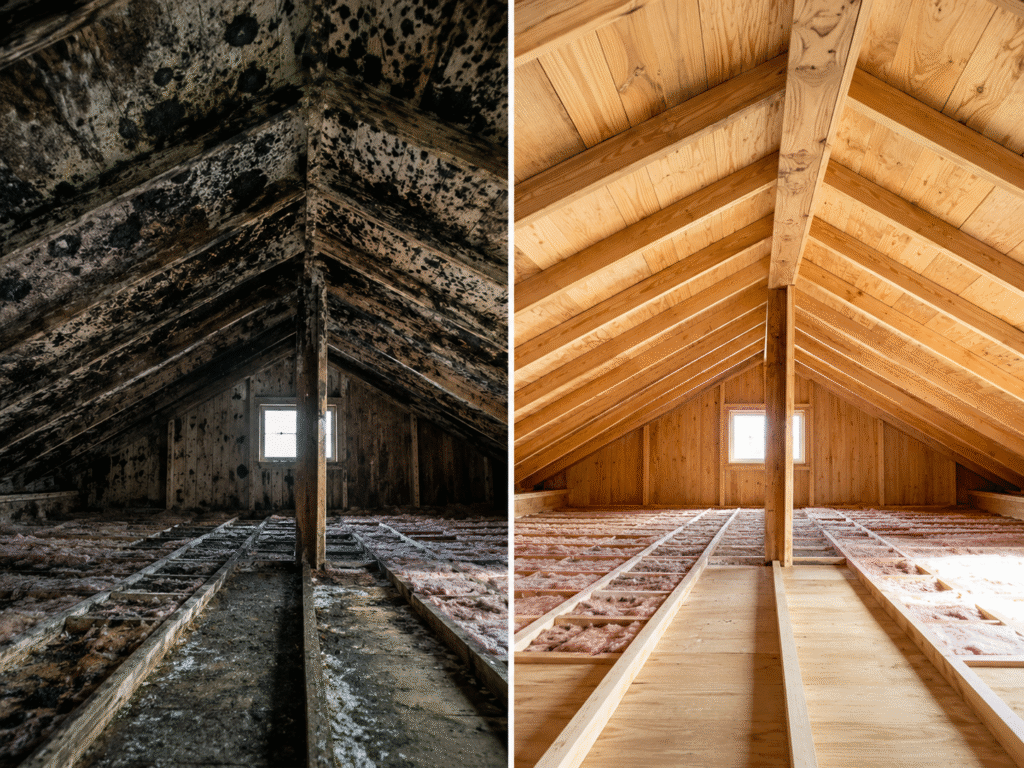
Is Black Mold Dangerous? The Honest Answer
“Black Mold” Is Not Actually a Species
This is the first thing worth understanding, because it dissolves a lot of the anxiety on its own. There is no organism called black mold. It is a popular term, not a scientific one, and the CDC has stated plainly that “toxic mold” is not an accurate description either.
Dozens of mold genera appear black. Cladosporium, Alternaria and Aspergillus niger are all common in New Jersey homes, all frequently dark in colour, and none of them are what people mean when they say black mold. The species people are actually picturing is Stachybotrys chartarum — and it is considerably less common in attics than it is in chronically saturated drywall, paper-faced insulation and water-damaged cellulose materials.
| DEFINITION: Stachybotrys chartarum: a greenish-black mold that requires prolonged, sustained moisture on cellulose-rich material to establish. In our experience, it is far more likely to be found behind a wall that has been wet for months than on attic sheathing exposed to seasonal condensation. |
What the CDC Actually Says About Stachybotrys
We would encourage you to read the CDC’s own page rather than take our word for it, but here is the substance of it:
• No test exists that proves an association between Stachybotrys chartarum and particular health symptoms.
• The suspected link between Stachybotrys and acute idiopathic pulmonary haemorrhage in infants — the cluster of cases that generated the entire toxic-mold panic — has never been proven.
• The CDC’s position is that Stachybotrys chartarum should be treated the same as any other household mold, not as a separate emergency category.
That is a remarkable thing to find on a mold remediation company’s website, and we are aware of it. But we would rather you trust us on the small claims so you trust us on the large ones.
Toxigenic Versus Toxic: The Distinction That Changes Everything
Almost every scare article online collapses these two words, and the collapse is what creates the fear.
| DEFINITION: Toxigenic means a mold is capable of producing mycotoxins under certain conditions. Toxic would mean the mold itself is poisonous. Molds are the former, not the latter — the CDC draws this distinction explicitly. |
The practical detail matters too. Only around a third of Stachybotrys chartarum strains produce trichothecene mycotoxins at all, and whether they do depends on the substrate and the environmental conditions. Finding the mold does not mean mycotoxins are present. And the EPA classifies mold as an allergen, not a toxin.
Where the Toxic Black Mold Panic Came From
Understanding the origin of a belief is usually more convincing than being told it is wrong. In the 1990s, a cluster of infant pulmonary haemorrhage cases in Cleveland was tentatively linked to Stachybotrys exposure. The story was covered widely, a wave of litigation followed, and “toxic black mold” entered the language permanently.
Subsequent review found the causal link unproven. But by then the term had escaped into public consciousness, and an entire industry had discovered it was extremely good for business. Thirty years later the fear is still doing commercial work, long after the science stopped supporting it.
Black Mold vs Regular Mold: Does the Colour Matter?
Short answer: no. Colour comes from species, pigmentation and the surface the mold is growing on. It tells you almost nothing about risk.
| Question | Black Mold (Stachybotrys) | Other Common Attic Molds |
| How common in NJ attics | Uncommon — needs sustained saturation | Very common — Cladosporium and Aspergillus dominate |
| Appearance | Dark greenish-black, often slimy when wet | Black, grey, green, white or brown |
| What it needs to grow | Prolonged water on cellulose-rich material | Far less — seasonal condensation is enough |
| Proven distinct health risk | Not proven distinct from other molds (CDC) | Allergenic and irritant effects documented |
| How we remediate it | Identical process | Identical process |
That final row is the point of the whole table. The remediation procedure does not change based on species. This is why paying for a species identification before remediation rarely makes financial sense, and it is why a company quoting you extra because you said the words “black mold” is charging you for a word rather than for work.
What Actually Determines Your Risk
Replace colour with these four factors, and you will assess your own situation more accurately than most articles will let you:
1. How much growth there is.
2. Whether spores are becoming airborne and circulating into your living space.
3. How long it has been growing.
4. Whether anyone in the household has asthma, allergies, or a compromised immune system.
Black Mold Attic Health Risks: What Is Actually Documented
Black Mold Symptoms Supported by Evidence
Mold exposure generally — not black mold specifically — is associated with:
• Nasal and sinus congestion.
• Throat irritation, coughing and wheezing.
• Eye irritation.
• Worsening of existing asthma.
• Allergic reactions in people already sensitised to mold.
These are real and worth taking seriously. They are also a considerably different list from the one circulating in the more alarming corners of the internet.
Who Is Genuinely at Higher Risk
• People with asthma or diagnosed mold allergies.
• Immunocompromised individuals, including anyone on immunosuppressive therapy.
• Infants and young children.
• Older adults.
• Anyone with a chronic respiratory condition such as COPD.
If someone in your household is on this list, move faster than you otherwise would. If nobody is, you have more time to plan than the internet suggested.
Is Attic Mold a Health Hazard If It Stays in the Attic?
This is the most common reason homeowners in Middletown, Holmdel and Marlboro Township tell us they left it for three years. It is also the one misconception on this page that we will push back on hard, because it is genuinely wrong.
Your attic is not sealed off from your living space. Warm air rises and exits the upper part of the house, drawing replacement air in below — the stack effect — and attic air is part of that circulation. Spores from attic growth reach the bedrooms underneath. This is the honest argument for dealing with attic mold, and it is far stronger than any toxicity claim, because it is actually true.
What the Evidence Does Not Support
We think naming these specifically is more useful than gesturing vaguely at misinformation:
• Memory loss, cognitive decline or neurological damage from ordinary residential attic exposure.
• Bleeding lungs in infants — the claim that started the panic, never proven.
• The idea that a black colour indicates a more dangerous mold.
• The idea that mold in a home constitutes a medical emergency requiring you to leave the house.
Identifying Black Mold in Your Attic
Black Mold on Attic Wood: What You Are Looking At
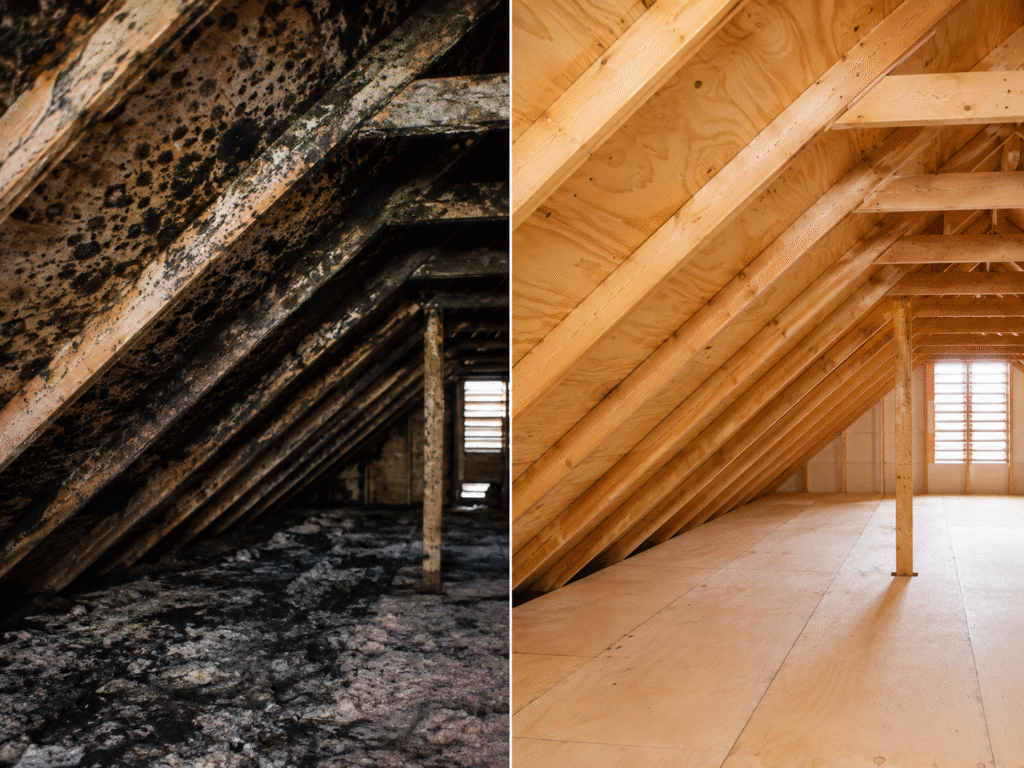
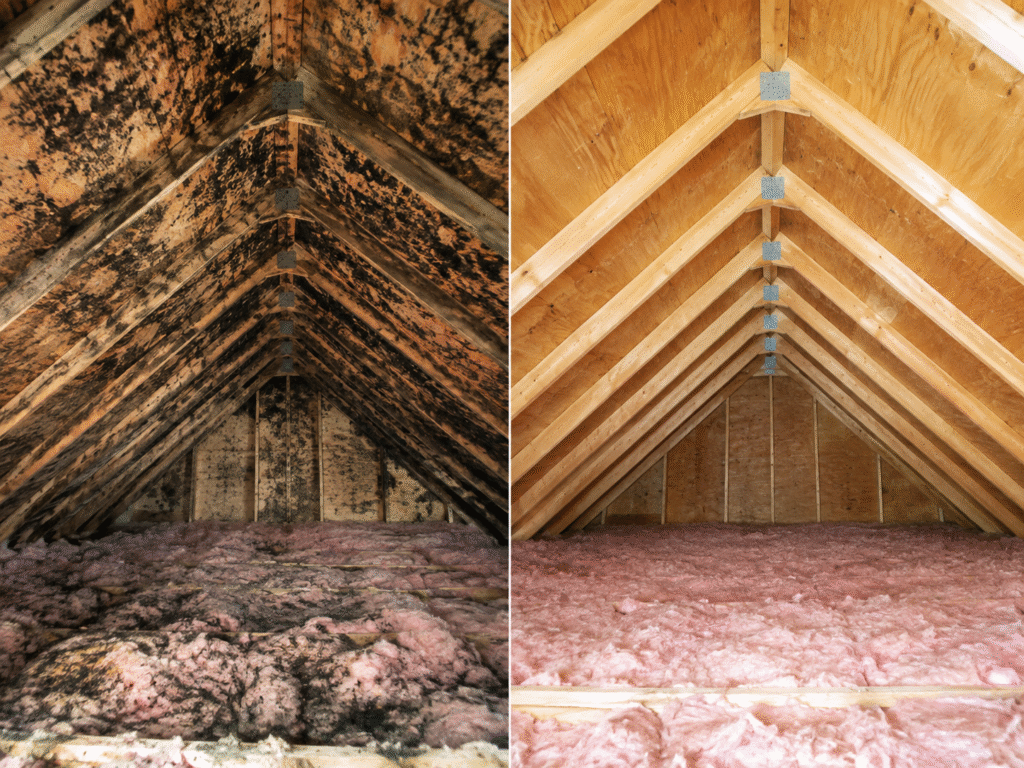
On plywood sheathing, attic mold typically shows as dark grey or black surface growth with visible texture. On OSB, it often appears first as darkening along the edges of the wood strands before spreading across the face.
Look at the pattern. If the growth runs in vertical streaks between the rafters and along the nail lines, and it is worst on the north-facing slope, you are looking at condensation mold — by far the most common finding in New Jersey attics. That pattern tells you the cause before any test does. We cover the mechanism in detail in our guide to what causes attic mold in NJ homes, so we will not repeat it here.
| EXPERT TIP: Reassurance worth having: surface growth on sheathing is generally not a structural problem in its early stages. It is growing on the wood, not consuming it. Structural damage comes from wood decay fungi, a different organism entirely. If your sheathing is discoloured but still firm when you press it, you are almost certainly looking at surface mold rather than rot. |
Four Things Commonly Mistaken for Black Mold
1. Soot or creosote staining, usually near a chimney chase.
2. Historic water staining — flat, dry, stable, with no texture. It marks where a problem used to be.
3. Blue stain fungus, which was in the lumber before it was ever installed and causes no ongoing harm.
4. Wood decay fungi, which is more serious than mold and needs structural assessment rather than remediation.
A practical field test: mold has texture and usually some colour variation across the growth. A stain is flat and uniform. Brush it lightly with a gloved finger — if material lifts, it is biological. If nothing lifts and the surface stays smooth, it is likely a stain.
Checklist: A Safe DIY Attic Check
1. Pick a cold morning. Condensation problems are visible in winter and effectively invisible in July.
2. Bring a bright flashlight and wear an N95 respirator.
3. Check the north-facing slope first.
4. Look along the nail lines and between the rafters for vertical streaking.
5. Check the nail tips for frost or beaded moisture.
6. Confirm the soffit vents at the eaves are clear and not buried in insulation.
7. Photograph anything questionable rather than touching it.
8. Come back down without cleaning anything.
| SAFETY WARNING: Never walk between the joists — attic floors are frequently just drywall, and you will come through the ceiling. Always wear an N95 or better before entering. Do not disturb, scrape or brush suspected growth without proper containment; that is precisely what puts spores into the air you breathe downstairs. If you have asthma, a respiratory condition, or a compromised immune system, do not go into the attic at all — send someone else or call a professional. |
Should I Worry About Attic Mold? A Straightforward Framework
Most articles on this topic answer this question with “yes, call immediately.” Here is a more useful answer.
Treat It as Urgent If:
• Anyone in the household has asthma, allergies, or is immunocompromised.
• The growth covers more than roughly 10 square feet.
• The sheathing feels soft or delaminated when pressed — that indicates decay, not surface mold.
• You are under contract to buy or sell the property.
• You can smell it from inside the living space.
You Have Time to Plan If:
• The growth is limited and confined to the surface of the sheathing.
• Nobody in the house is experiencing respiratory symptoms.
• There is no active roof leak.
• You are not transacting on the property.
In that second scenario it is entirely reasonable to get an inspection, understand the scope, and schedule the work for a month that suits you and your budget. We would rather tell you that than pressure you into an emergency you are not actually having.
The Four Real Reasons to Remove It Anyway
1. Indoor air quality. The stack effect means attic air reaches your living space, whether or not anyone currently feels it.
2. Moisture damage. The mold is a symptom. The underlying condensation is degrading your insulation’s performance and, over years, the sheathing itself.
3. Property transactions. It will be found at inspection, and unresolved findings routinely cost more in buyer concessions than the remediation would have.
4. It does not resolve itself. Every winter the same cycle repeats and the affected area grows.
Notice that none of those four reasons is toxicity. That is deliberate, and it is the honest case for doing the work.
Attic Mold Testing in NJ: When It Is Worth Paying For
When Testing Changes the Outcome
• You need documentation for a real estate transaction or an insurance claim.
• Someone has unexplained respiratory symptoms and the source has not been located.
• There is a dispute — landlord and tenant, or buyer and seller.
• You want post-remediation verification that the work achieved what it was supposed to.
When Testing Does Not Change Anything
If you can see the growth and you already know it needs to come out, identifying the species will not alter the remediation procedure or the price. Some companies sell testing on every job because it is profitable. We recommend it when it is useful and tell you when it is not, which is more often than you might expect.
What a Proper Test Involves
1. Air sampling with a calibrated pump drawing a measured volume of air over a known period.
2. A simultaneous outdoor control sample taken the same day — without it, indoor spore counts mean nothing, because outdoor air always contains mold.
3. Analysis by an accredited independent laboratory, not by the company selling you the remediation.
4. A walkthrough of the results with you, line by line, rather than an emailed PDF and silence.
| EXPERT TIP: A word on DIY petri-dish kits: something grows in almost every home, because mold spores exist in the air of every building on earth. Without an outdoor control sample there is no baseline, and a positive result carries no information about whether your home is abnormal. If you have already bought one and been alarmed by the result, bring it up when you call and we will tell you honestly what it does and does not show. |
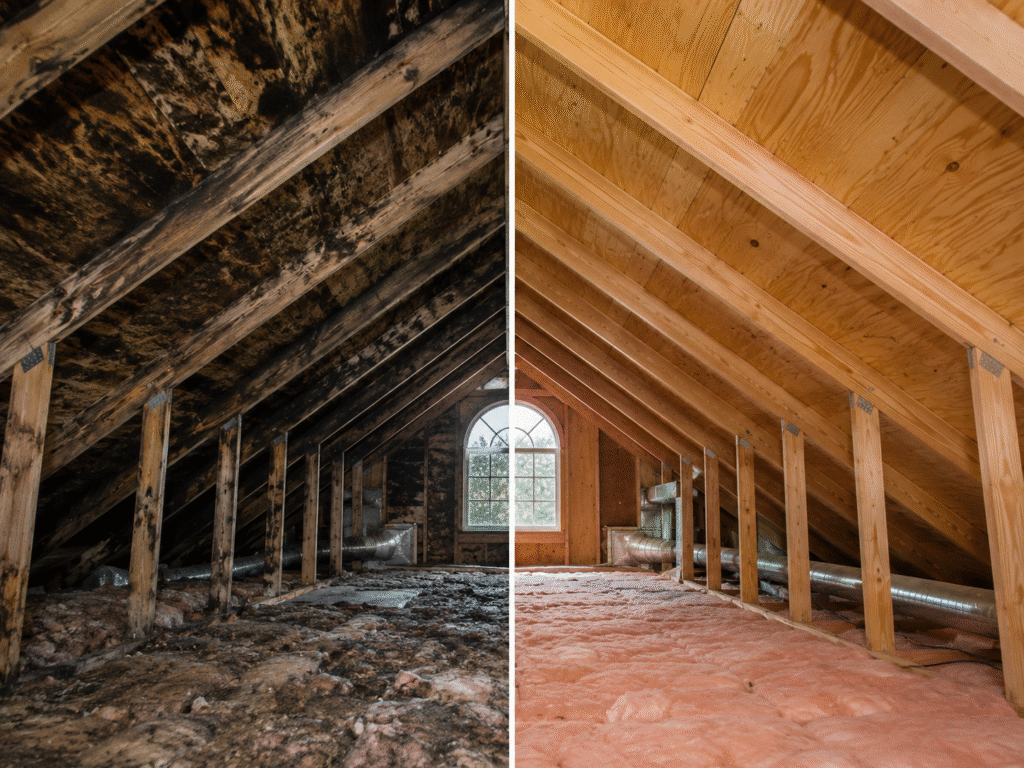
How to Remove Black Mold in the Attic: The Professional Process
Proper attic black mold removal follows a defined order, and the order matters as much as the individual steps.
1. Inspection and moisture mapping, with meter readings taken in the sheathing itself.
2. Identify and correct the moisture source. This comes before remediation, not after.
3. Set up containment and negative air pressure so spores are not distributed into the living space during the work.
4. Remove the growth and apply an antimicrobial.
5. Remove and replace contaminated insulation — it is porous throughout and cannot be effectively treated.
6. Correct the ventilation and air-seal the ceiling plane.
7. Verify the result, with post-remediation testing where the situation warrants it.
| EXPERT TIP: Step 2 is where most failed remediations go wrong. Cleaning an attic before correcting ventilation, air leakage or an active roof leak guarantees the mold returns. If a company quotes you for cleaning without discussing why the mold grew, they are selling you the same job twice. |
Why DIY Black Mold Removal in an Attic Usually Fails
• Bleach is roughly 94% water. On porous wood the chlorine stays on the surface while the water soaks in and feeds the growth underneath. This is the single most common client mistake we encounter.
• Scraping or sanding without containment aerosolises spores straight into the house below, through the same stack effect described earlier.
• Cleaning without correcting ventilation means the growth returns within two or three winters.
• Attics are genuinely hazardous work environments — heat, poor footing, limited egress and no easy way out if something goes wrong.
Five Red Flags in a Black Mold Quote
1. A price given over the phone with nobody inspecting the attic.
2. Encapsulation proposed with no mention of ventilation or air sealing.
3. “Toxic mold” language used to justify a premium price.
4. The same company performing both the testing and the remediation, with no independent laboratory involved.
5. Pressure to sign the same day, or a discount that expires that afternoon.
Black Mold Removal Cost in New Jersey
What Actually Drives the Price
1. The square footage of affected sheathing.
2. Attic access. A walk-up staircase with standing headroom is a completely different job from a small hatch with three feet of clearance.
3. Whether contaminated insulation has to be removed and replaced.
4. How much ventilation correction and air sealing the attic needs.
5. Whether testing is included in the scope.
Does “Black Mold” Cost More to Remove Than Other Mold?
No. The remediation procedure is identical regardless of species, so the price should be identical too.
We are telling you this because it is the most common way homeowners get overcharged on this particular service. A homeowner calls, says the words “black mold,” and the quote comes back higher than it would have if they had said “attic mold” — for work that is exactly the same. You have no way to know it happened.
| EXPERT TIP: Ask every company you call this question directly: “Would this quote be different if I had described it as regular attic mold instead of black mold?” The answer, and how comfortable they are giving it, will tell you a great deal about who you are dealing with. |
Keeping Black Mold From Coming Back
Prevention comes down to one principle applied in the right order: seal the ceiling plane first, then correct the ventilation, then insulate. Doing it in any other sequence is why so many attics get “fixed” more than once.
• Check for frost on the nail tips on a cold winter morning. It is the earliest warning available to a homeowner and it costs nothing.
• Confirm bathroom and dryer exhaust terminate outside the building, not in the attic.
• Keep insulation clear of the soffit vents using baffles.
• Inspect in autumn, before the heat comes on for the season.
For the full explanation of why attic mold forms in New Jersey homes and how to stop it permanently, see our detailed guide on what causes attic mold in NJ homes.
Black Mold Inspection Across Monmouth County and Nearby NJ Towns
What we find in an attic depends a great deal on where in New Jersey that attic is.
Shore Communities: Monmouth Beach, Long Branch, Deal, Atlantic Highlands, Belford, Union Beach and Seaside Heights
These towns share elevated year-round humidity and a quieter problem most homeowners never consider: salt air gradually corrodes vent hardware, so soffit screens and ridge vent baffles clog and close off over the years without anyone touching them. There is also a high proportion of seasonal properties standing closed and unconditioned from October through May.
That last point matters for this article specifically. A property sealed for seven months with no air movement is one of the few situations in New Jersey where sustained-moisture species genuinely become plausible. If you close a shore property for the season, the attic is worth a look before you lock up rather than after you return.
Inland Monmouth County: Holmdel, Colts Neck, Marlboro Township, Middletown, Tinton Falls, Little Silver, Rumson, Oceanport and Eatontown
Homes here tend to be larger with more complicated roof geometry — multiple dormers, valleys, hips and cathedral sections. That complexity creates dead-air pockets that standard soffit-and-ridge ventilation never reaches, and growth appears in those pockets while the rest of the attic looks perfectly fine. These towns also have a high rate of insulation retrofits that buried the soffit intake without baffles, which is one of the most common self-inflicted causes we see.
North and Central New Jersey: Edison and Jersey City
Older and denser housing stock, more attached and semi-detached construction with limited gable access, and a significant number of attics converted to living or storage space with no redesign of the ventilation. Converted attics are a particular concern, because insulating a roofline without leaving a ventilation channel above the insulation removes the drying capacity entirely. These towns sit outside our Monmouth County core, but the building patterns are consistent enough that the diagnosis is usually straightforward.
When to Call a Professional in New Jersey
Use the urgency framework above to decide when. Use this section to decide who.
What a Proper Attic Inspection Should Include
• Moisture meter readings taken in the sheathing itself, not a visual estimate from the hatch.
• Assessment of the attic’s ventilation against code requirements.
• Tracing of every exhaust duct to its termination point.
• Photographs you keep, whether or not you hire the company.
• A written scope that separates remediation from moisture correction.
• An explicit statement of what does not need doing.
Important: New Jersey Does Not License Mold Contractors
Every New Jersey homeowner should know this before hiring anyone, and very few contractors will volunteer it.
New Jersey does not license mold assessors or mold remediators at state level. As of 2026, only Florida, Texas, New York and Washington DC license both. In practice, that means anyone in this state can print business cards tomorrow and call themselves a mold company, with no state credential required at all.
Since there is no licence to verify, here is what to check instead:
1. New Jersey Home Improvement Contractor registration. It is required, and you can verify it free through the NJ Division of Consumer Affairs. Ask for the number and look it up.
2. General liability insurance and, specifically, pollution liability coverage. Standard liability policies frequently exclude mold work entirely. Ask to see the certificate.
3. Third-party certification through a recognised body such as the IICRC, ACAC or NORMI. These are voluntary in New Jersey — which is exactly why they mean something.
4. References from completed work in your own town, not a testimonials page.
Why Choose MMRG for Attic Black Mold Removal in New Jersey
It is more useful to tell you what we will not do.
• We will not charge a premium because you used the words “black mold.” The process is the same, so our price is the same.
• We will not use “toxic mold” language to make a job sound more urgent than it is. If this whole article has a thesis, that is it.
• We will not quote attic black mold removal without inspecting the attic first.
• We will not use dry ice blasting as a substitute for correcting the moisture source. It is faster and easier for us, and it does not solve the problem.
• We will not quote remediation you do not need. A meaningful share of our free inspections end with us telling a homeowner the staining is historic and nothing needs doing.
• We will not send a commissioned salesperson to your kitchen table. The person who inspects your attic is an inspector.
MMRG is a New Jersey-registered Home Improvement Contractor, HIC #13VH07910200, fully insured, based at 1 Griffin Pl in Ocean Township. We serve Monmouth County and most of New Jersey, and we will give you references from work in your own area before you commit to anything at all.
Get a Free Attic Black Mold Inspection Anywhere in New Jersey
If you have seen dark staining on your roof sheathing and you are not sure what you are looking at, we will come and tell you. Free, on site, about thirty minutes. You get moisture readings, photographs you keep, and a straight answer.
And if it turns out you do not need remediation, we will say so and leave.
Or call 908-601-1307 to book your free attic inspection.
Frequently Asked Questions About Black Mold in NJ Attics
Is black mold in my attic dangerous to my family?
Far less than most websites claim — the CDC states Stachybotrys has never been proven to cause the severe illnesses attributed to it, though allergic and respiratory symptoms are real, particularly for asthma sufferers.
How can I tell if it is toxic black mold?
You cannot tell by looking, because colour does not indicate toxicity and dozens of common molds appear black.
Does black mold cost more to remove than regular mold?
No, because the remediation procedure is identical regardless of species, so be cautious of any quote that rises after you use the words “black mold.”
Is attic mold a health hazard if it stays in the attic?
Yes, because the stack effect draws attic air down into your living space, so attic mold does not stay in the attic.
Should I worry about attic mold if nobody feels sick?
You can reasonably plan rather than panic if the growth is limited and nobody has respiratory conditions, but it still needs addressing because it worsens every winter.
Does New Jersey require a licence for black mold remediation?
No — New Jersey licenses neither mold assessors nor remediators, so verify Home Improvement Contractor registration, pollution liability insurance and IICRC or ACAC certification instead.
Do you inspect for black mold outside Monmouth County?
Yes, we handle attic black mold inspection and remediation across most of New Jersey, including Edison and Jersey City, from our base in Ocean Township.