
By Randy Cece · MMRG Mold Remediation & Basement Waterproofing · 20+ years in mold remediation
| QUICK ANSWER: Attic mold removal matters more in Jersey City than in most New Jersey towns because of what the buildings are. Nearly 29% of Jersey City housing was built before 1939, most of it attached, and in that stock the space above your top-floor ceiling is usually a cockloft or flat-roof cavity rather than a ventilated attic. Moisture has nowhere to escape, and in rowhouses that cavity can run across several adjoining buildings — so the problem does not always stop at your wall. |
That last point is the one most Jersey City property owners have never been told, and it changes how urgently this should be handled.
Why Jersey City Attics Are Different From the Rest of New Jersey
Most attic mold advice online is written for detached suburban houses with pitched roofs, soffit vents and a ridge vent. If you own or rent in Jersey City, a fair amount of that advice does not describe your building at all.
Here is what the housing data actually shows:
| Jersey City housing | Figure | Why it matters |
| Built before 1939 | 28.77% | Among the oldest housing stock in America. Predates modern attic ventilation requirements entirely |
| Median construction year | 1971 | Even the newer half of the stock predates current standards |
| Renter-occupied | 72.1% | Most people affected by attic mold here are tenants, landlords or property managers — not owner-occupiers |
| Owner-occupied | 27.9% | The minority, though concentrated in The Heights, Bergen-Lafayette and parts of Greenville |
| Downtown detached single-family | 1.7% | Almost nothing downtown has a conventional attic |
Three consequences follow from that. Older buildings frequently have no purpose-built ventilation above the top floor. Attached construction means the cavity above your ceiling may be continuous with your neighbour’s. And because most units are rented, the person who notices the problem is usually not the person who has to pay for it — which is why this article covers responsibility as well as remediation.
Attic, Cockloft or Flat Roof Cavity? Know What You Actually Have
Getting this right matters, because the diagnosis and the fix differ.
| DEFINITION: Attic — a ventilated space beneath a pitched roof, tall enough to enter, usually with soffit and ridge or gable ventilation. Common in The Heights and in detached homes across Jersey City’s outer neighbourhoods. |
| DEFINITION: Cockloft — a horizontal void between the top-floor ceiling and the roof deck, with little or no access and typically of combustible construction. Common in older rowhouses and commercial buildings. Critically, a cockloft may extend across multiple adjoining occupancies or buildings. |
| DEFINITION: Flat roof cavity — the shallow space between ceiling and roof deck in a flat-roofed building, often insulated at the ceiling with no ventilation path at all. |
| DEFINITION: Converted attic — an attic finished into living or storage space, frequently without any redesign of the ventilation. Insulating a roofline without leaving a ventilation channel above the insulation removes the building’s drying capacity completely. Very common in Jersey City. |
| EXPERT TIP: If a contractor talks to you about your soffit vents and north-facing roof slope while standing in a Paulus Hook brownstone, they are describing a building they have not looked at. Ask them what is above your top-floor ceiling before you ask them for a price. |
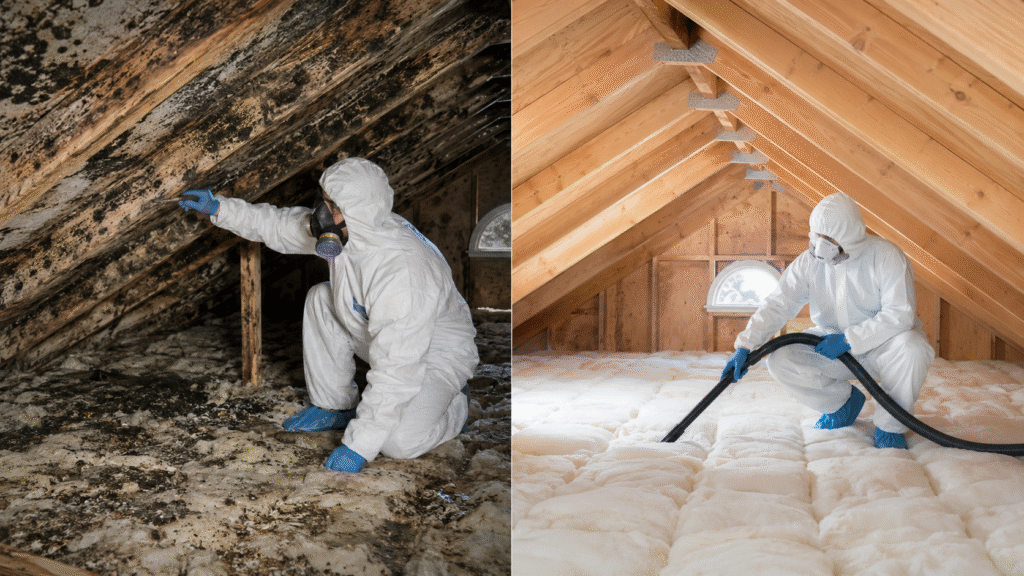
Why Do Old Buildings Get Attic Mold?
Mold needs moisture, and older Jersey City buildings supply it through several routes at once:
1. No designed ventilation. Buildings from before 1939 were not built to modern ventilation standards. Current code sets net free ventilating area at 1/150 of the vented space, but a sealed cockloft has effectively none.
2. Condensation on cold decking. Warm, humid air from showers, cooking and laundry rises through gaps in the ceiling, meets the cold underside of the roof deck in winter, and condenses. Once wood reaches roughly 20% moisture content, mold has what it needs.
3. Retrofitted insulation with no baffles. Insulation added for energy efficiency frequently blocks whatever intake ventilation existed, which makes the cavity wetter rather than drier.
4. Bathroom and dryer exhaust discharging into the cavity. Common in older buildings where a bathroom was renovated without anyone considering where the duct terminates.
5. Aging flat roofs. Flat and low-slope roofs pond water and fail at seams and flashings. A slow leak into a cockloft can run for months without producing a visible ceiling stain.
6. Converted attics with sealed rooflines. Insulating directly against the roof deck with no ventilation channel traps moisture in the assembly.
None of these is exotic. Most Jersey City buildings with attic or cockloft mold have two or three of them at once.
Signs of Attic Mold in a Jersey City Home or Apartment
In a building with no accessible attic, you will almost always notice the symptom before you find the source.
• A musty smell on the top floor that is strongest in closets, near the ceiling, or by the roof hatch.
• Black spots on the ceiling of a top-floor apartment, particularly near exterior walls or in corners.
• Water stains on the top-floor ceiling, whether or not they are currently damp.
• Paint blistering or bubbling on the ceiling.
• Allergy or asthma symptoms that improve when you leave the building and return within hours of coming back.
• Higher summer cooling costs, from insulation that has absorbed moisture and lost its R-value.
Why Can I Smell Mold But Not Find It?
Because in most Jersey City buildings the growth is in a cavity you cannot see into. A cockloft has little or no access. A flat roof assembly has none. The smell reaches you through the same route the moisture took to get up there — gaps around light fixtures, the ceiling hatch, plumbing penetrations and the top plates of walls.
This is the single most common reason mold goes unaddressed in older buildings for years. Nobody can see it, so nobody is certain it is there. A borescope inspection through a small access point, combined with moisture readings and a thermal camera, resolves the question in under an hour without opening up the ceiling.
Does My Apartment Building Have Attic Mold?
You cannot confirm it from inside the unit, but you can assess the likelihood. If the building predates 1939, has a flat roof, has had any roof leak in recent years, has top-floor units that smell musty, or has had insulation added without ventilation work, the probability is meaningful. In a multi-unit building, ask whether other top-floor tenants have noticed the same smell. If two or three have, you are almost certainly dealing with a shared cavity rather than a unit-specific problem.
Can Mold Spread Between Apartments in Jersey City?
| QUICK ANSWER: Yes, and in attached Jersey City buildings the cockloft is the usual route. A cockloft may create a single continuous void spanning multiple adjoining occupancies or buildings, so moisture, odour and spores can travel between units above the ceiling line — even where the party walls below are sound. This is why a mold problem in one top-floor apartment often turns out to affect the whole row. |
Fire services have understood this about cocklofts for decades, which is why the space is a standard concern in rowhouse firefighting: what enters one cockloft can move along the row. The same geometry applies to moisture.
For a homeowner in an attached building, this has a practical implication. If your neighbour has an unrepaired roof leak and your buildings share a cockloft, your ceiling may be the one that shows the stain. Remediating your side without addressing the source next door will not hold.
| EXPERT TIP: For condo boards, co-op boards and HOAs: a shared cockloft usually means the affected area is a common element rather than unit interior, which changes who is responsible for paying. Check your governing documents before individual owners start commissioning their own remediation — it is a common and expensive mistake. |
Who Pays for Mold Remediation — Landlord or Tenant?
| QUICK ANSWER: In New Jersey, the landlord is normally responsible. New Jersey has no mold-specific statute, but courts recognise an implied warranty of habitability requiring landlords to keep rental units fit for residential use throughout the lease. That duty cannot be waived by a clause in the lease. Where mold arises from a building defect such as a roof leak or absent ventilation, remediation is the landlord’s obligation. |
The exception is mold a tenant caused — for example by disabling a bathroom fan, blocking ventilation, or failing to report a leak they knew about. In attic and cockloft cases that exception rarely applies, because tenants have no access to the space and no control over the roof.
How Long Does a Landlord Have to Fix Mold in NJ?
There is no fixed statutory number of days. New Jersey law requires the tenant to give notice and the landlord a reasonable opportunity to repair, with what counts as reasonable depending on severity. The process generally runs as follows:
1. Notify the landlord in writing. Certified mail with return receipt is the standard advice, because it creates proof of the date notice was given.
2. Allow reasonable time to repair. Keep a record of what was promised and when.
3. If nothing is done, tenants in New Jersey may have several remedies — repair and deduct, asking a court to abate or withhold rent, or asking a court to order repairs or compensation.
4. In serious cases where the unit is genuinely unfit, constructive eviction may apply, which can end the tenant’s obligation for future rent.
| SAFETY WARNING: We are a remediation contractor, not a law firm, and nothing here is legal advice. For your specific situation consult an attorney or contact the New Jersey Department of Community Affairs, which publishes guidance on habitability. What we can do is provide the independent written documentation that these processes depend on. |
What Both Sides Actually Need: Documentation
Almost every landlord-tenant mold dispute we are asked about comes down to evidence rather than disagreement about the mold itself. An independent inspection with written findings, moisture readings and dated photographs protects both parties. For a landlord, it proves either that there is no problem or that you acted promptly on notice. For a tenant, it converts a complaint into a documented condition.
| Situation | What documentation does |
| Tenant reports mold, landlord unsure | Independent findings settle whether remediation is genuinely needed |
| Landlord acted, tenant disputes adequacy | Post-remediation verification demonstrates the work achieved its objective |
| Insurance claim | Dated moisture readings and photographs are what carriers accept |
| Habitability proceeding | Third-party written report carries weight that either side’s opinion does not |
| Condo or co-op dispute | Establishes whether the source is common element or unit interior |
What an Attic Mold Inspection in Jersey City Should Include
Given that most of these buildings have no walk-in attic, a proper inspection here looks different from a suburban one:
• Moisture meter readings taken in the actual ceiling and roof structure, not a visual estimate from a doorway.
• Thermal imaging to locate cold and damp areas behind finished ceilings without demolition.
• Borescope inspection through a small access point where the cavity cannot otherwise be reached.
• Assessment of whether any ventilation path exists at all, and what could realistically be created.
• Roof condition review, since flat roofs are the usual water source in this stock.
• Tracing of bathroom, kitchen and dryer exhaust to confirm where each terminates.
• Photographs you keep, whether or not you hire the company.
• A written scope separating remediation from the moisture correction it depends on.
• A clear statement of what does not need doing.
Multi-Family and Commercial Mold Remediation in Jersey City
Because Jersey City is overwhelmingly rental and multi-family, a large share of attic and cockloft mold work here is not a single-family job. That changes the requirements:
• Scheduling around occupied units, with notice periods and access coordination across multiple tenants.
• Containment planned so that work in one unit does not distribute spores into neighbouring units through the shared cavity.
• Phased work where the whole row or building cannot be treated at once.
• Documentation suitable for a managing agent, an insurer, a board or an attorney.
• Clear separation in the scope between common element and unit interior, so the right party is billed.
• Coordination with a roofer where the moisture source is the roof rather than the ventilation.
If you manage several buildings in Hudson County, inspections can be scheduled together and reported consistently across the portfolio, which is generally cheaper and considerably easier to act on than commissioning them one at a time.
How Much Does Attic Mold Removal Cost in Jersey City?
Cost varies more in this building stock than in suburban New Jersey, because access is the dominant variable. Six factors set the price:
1. Affected square footage of ceiling structure or roof deck.
2. Access. A walk-up attic is straightforward. A sealed cockloft requiring access points to be created is not — this is usually the largest single cost driver in Jersey City.
3. Whether contaminated insulation must be removed and replaced.
4. Whether any ventilation can be created, and what that involves in a flat-roofed or attached building.
5. Whether the roof itself needs attention first.
6. Whether testing and post-remediation verification are included.
7. Occupancy. Working around tenants in an occupied multi-family building costs more than an empty single-family attic.
| Project pricing is not dictated by the building category alone. Whether you have a single-family attic or a multi-unit complex, the investment depends on the distinct dimensions, intensity, and technical requirements of your mold issue.Several variables drive the final cost: the total square footage of the contaminated structure, the depth of the growth, and how difficult the space is to access. Other drivers include the specific materials involved, the level of containment required to protect the rest of the building, and whether insulation or personal contents must be removed. Most importantly, the price reflects whether a moisture source must be corrected to ensure the fix is permanent.Because every Jersey City property presents unique structural challenges, we do not provide generic estimates or standardized price brackets based on building type. We conduct a thorough evaluation of your specific conditions before any price is determined. |
Does Homeowners or Landlord Insurance Cover It?
It depends on the moisture source. Damage from a sudden covered event, such as a storm-damaged roof or a burst pipe, is more likely to be covered. Damage from long-term condensation or deferred maintenance is typically excluded as a maintenance issue. Read the specific policy and speak to the carrier. We can supply the documentation a claim requires, but no contractor can promise you an outcome.
How to Prevent Attic Mold in an Older Building
In a building with limited or no ventilation, prevention works from the inside out — the order matters more here than in a suburban attic, because you often cannot simply add vents.
1. Air-seal the ceiling plane first. Light fixtures, the roof hatch, plumbing penetrations, wiring holes and wall top plates. In a sealed cockloft this is the primary defence, because if moisture cannot get up there, it cannot condense.
2. Fix exhaust termination. Every bathroom, kitchen and dryer duct must discharge outside the building, not into the cavity and not at a soffit where it is drawn straight back in.
3. Manage indoor humidity. Run bathroom fans during and after showers, and use a dehumidifier on the top floor during humid months.
4. Maintain the roof. Flat roofs need inspection at least annually, and after any significant storm. Most cockloft moisture in this stock arrives through the roof.
5. Create ventilation where the structure allows. Sometimes possible during a roof replacement. Frequently it is not, which is why steps 1 and 2 carry more weight here.
6. Inspect after any roof work. A repaired leak does not undo what the water already did above the ceiling.
When to Call a Professional in Jersey City
Treat It as Urgent If
• Anyone in the household has asthma, allergies or a compromised immune system.
• The ceiling is soft, sagging or actively wet.
• Multiple units in the building report the same smell — that indicates a shared cavity.
• You are buying, selling or in a habitability dispute.
• A roof leak has occurred and nobody has assessed what happened above the ceiling.
You Have Time to Plan If
• The staining is limited, dry and stable.
• Nobody in the building has respiratory symptoms.
• There is no active leak.
• You are not transacting or in dispute.
• In that case, get the inspection, understand the scope, and schedule the work when it suits your budget.
Important: New Jersey Does Not License Mold Contractors
Every New Jersey property owner should know this, and few contractors will tell you. New Jersey does not license mold assessors or remediators at state level — as of 2026 only Florida, Texas, New York and Washington DC license both. Anyone here can call themselves a mold company with no state credential.
Since there is no licence to check, verify these instead:
1. New Jersey Home Improvement Contractor registration, verifiable free through the NJ Division of Consumer Affairs. Ask for the number and look it up.
2. General liability insurance and specifically pollution liability, since standard policies often exclude mold work. Ask to see the certificate.
3. Third-party certification such as IICRC, ACAC or NORMI. These are voluntary in New Jersey, which is exactly why they mean something.
4. References from work in buildings like yours — attached, multi-family, flat-roofed — not just suburban attics.
Why Choose MMRG for Attic Mold Removal in Jersey City
• We inspect before we quote. No price is given over the phone for a building nobody has looked at.
• We identify what you actually have — attic, cockloft or flat roof cavity — and scope accordingly.
• We correct the moisture source. Remediation without it is temporary by definition.
• We provide written documentation suitable for landlords, tenants, boards, insurers and attorneys.
• We tell you when remediation is not needed, and a meaningful share of our free inspections end that way.
• Licensed inspectors carry out the assessment, not commissioned salespeople.
• New Jersey-registered Home Improvement Contractor, HIC #13VH07910200, fully insured.
| IAQA & ESA certified. MMRG began operating in New Jersey in 2012. |
Book a Free Attic Mold Inspection in Jersey City
If there is a musty smell on your top floor, staining on the ceiling, or a roof leak nobody has followed up on, the inspection costs nothing. You get moisture readings, photographs you keep, and a written answer about whether remediation is needed.
If it turns out you do not need us, we will tell you that and leave.
Or call 908-601-1307 to book. We serve Jersey City, Hudson County and most of New Jersey.