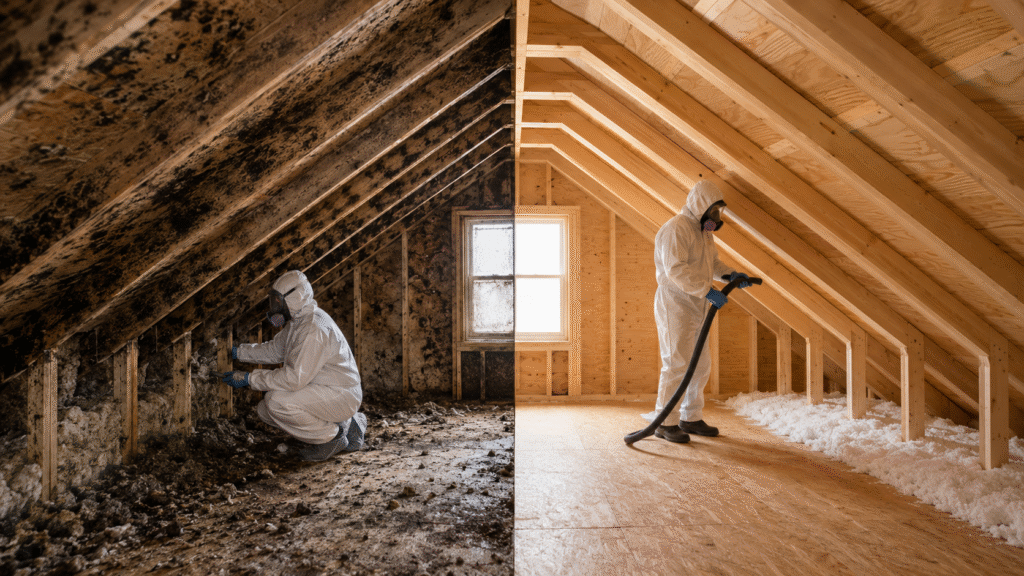
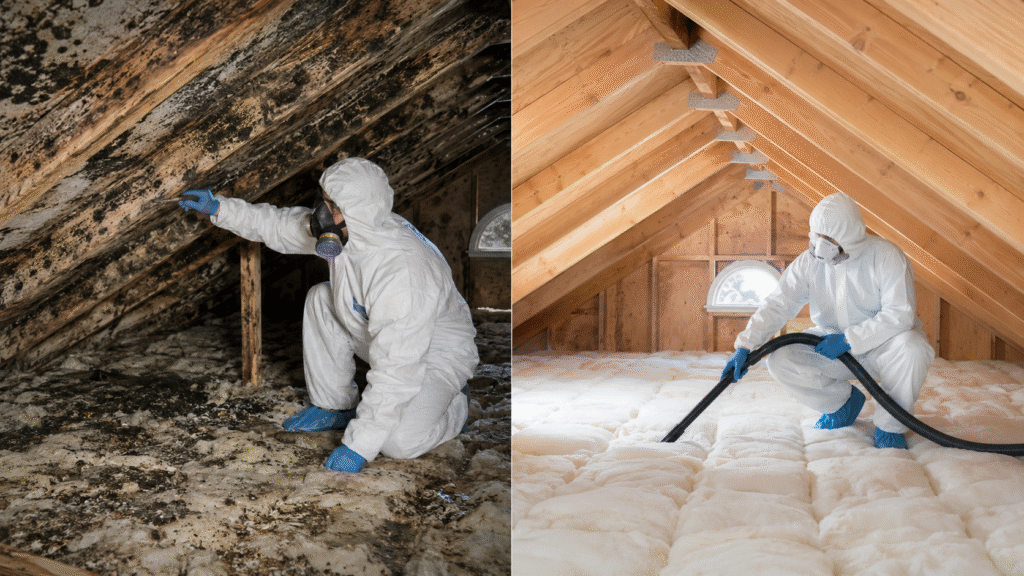
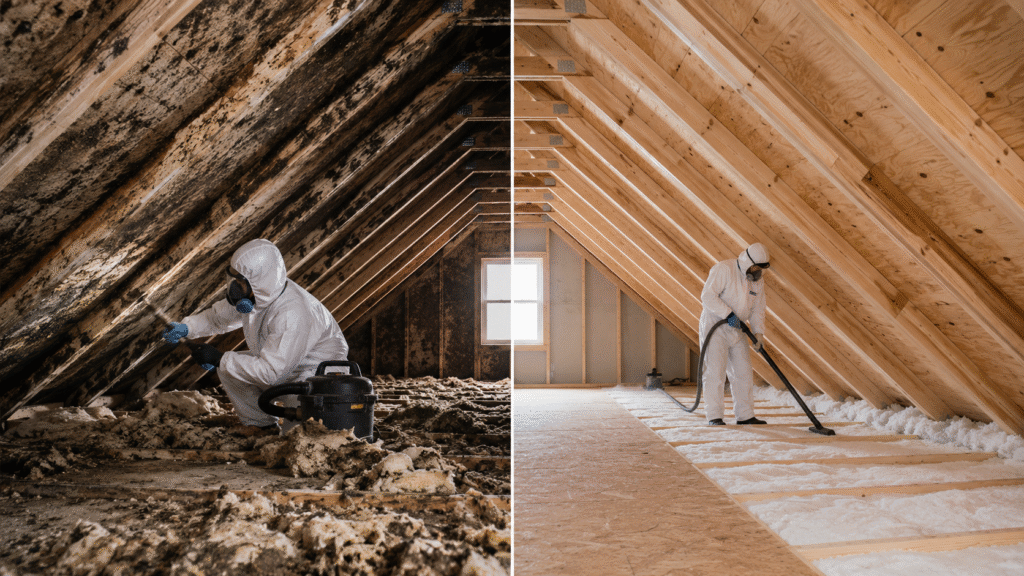
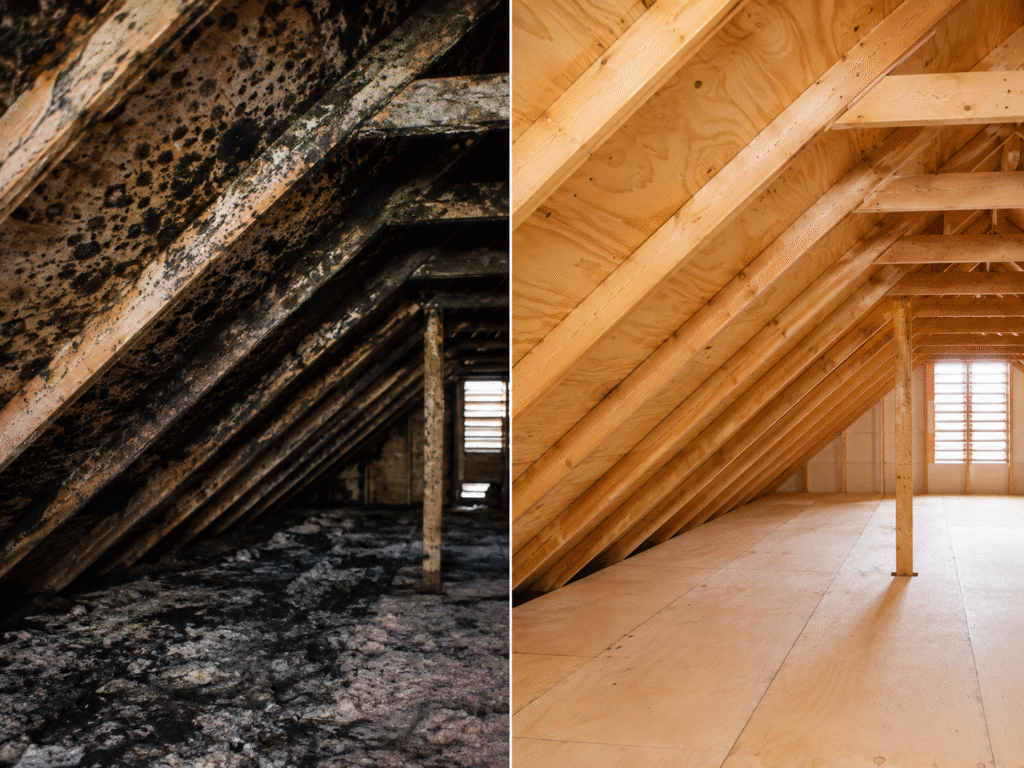
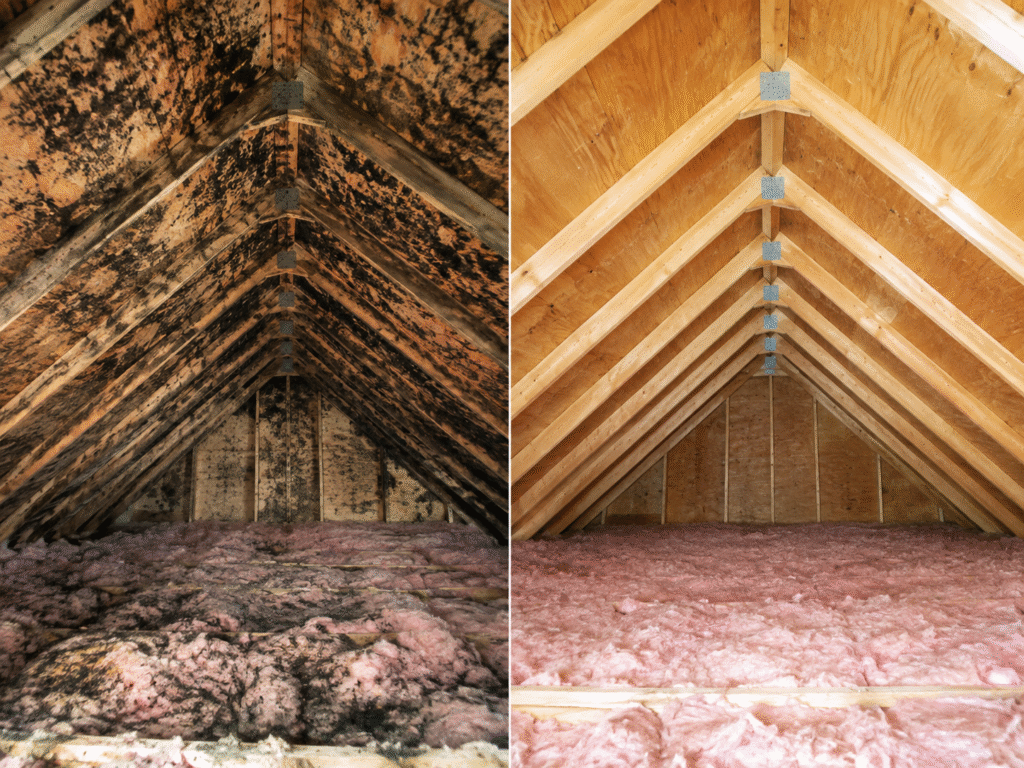
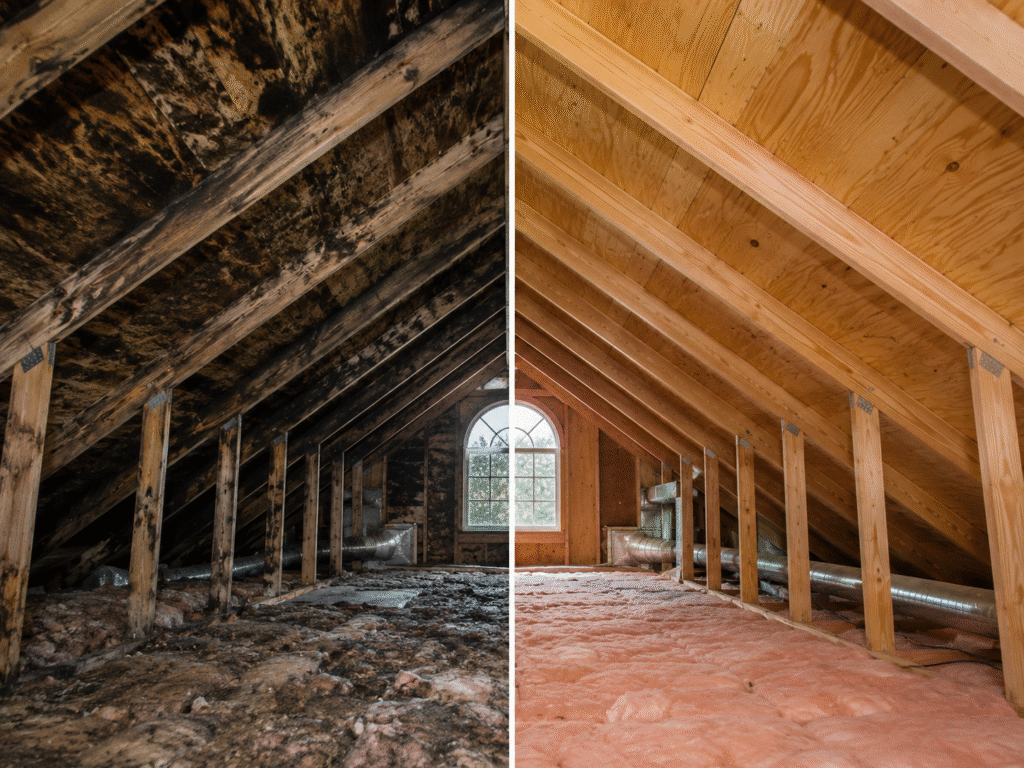
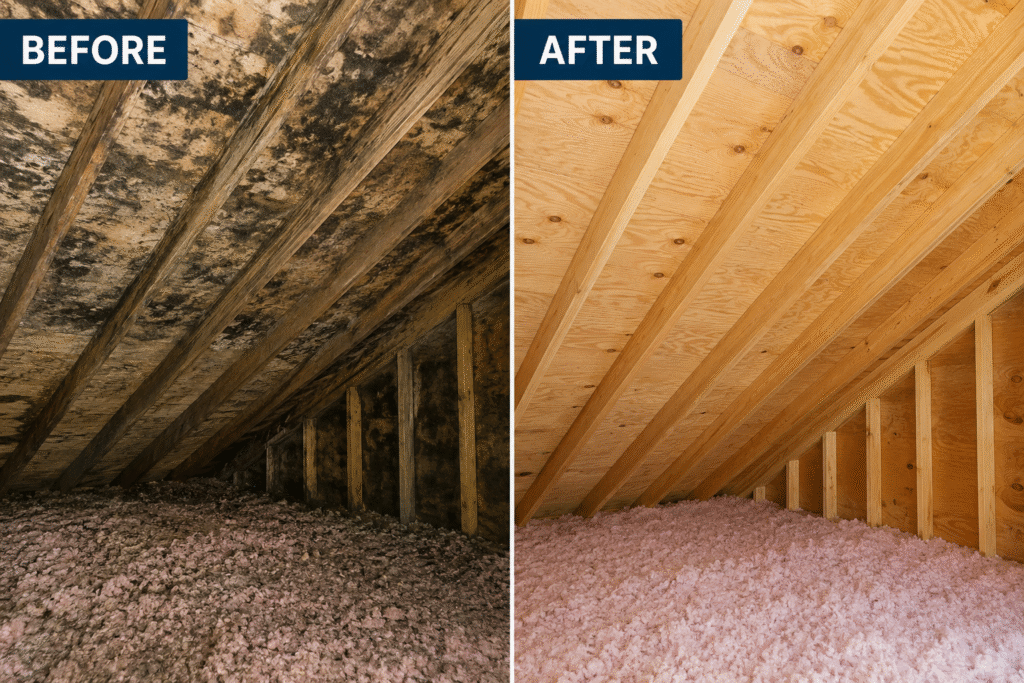
Why Attic Mold Removal Is Critical for Homes in Jersey City, NJ

By Randy Cece · MMRG Mold Remediation & Basement Waterproofing · 20+ years in mold remediation

QUICK ANSWER: Attic mold removal matters more in Jersey City than in most New Jersey towns because of what the buildings are. Nearly 29% of Jersey City housing was built before 1939, most of it attached, and in that stock the space above your top-floor ceiling is usually a cockloft or flat-roof cavity rather than a ventilated attic. Moisture has nowhere to escape, and in rowhouses that cavity can run across several adjoining buildings — so the problem does not always stop at your wall.
attic mold removal Jersey City

That last point is the one most Jersey City property owners have never been told, and it changes how urgently this should be handled.

Why Jersey City Attics Are Different From the Rest of New Jersey

Most attic mold advice online is written for detached suburban houses with pitched roofs, soffit vents and a ridge vent. If you own or rent in Jersey City, a fair amount of that advice does not describe your building at all.

Here is what the housing data actually shows:

Jersey City housingFigureWhy it matters
Built before 193928.77%Among the oldest housing stock in America. Predates modern attic ventilation requirements entirely
Median construction year1971Even the newer half of the stock predates current standards
Renter-occupied72.1%Most people affected by attic mold here are tenants, landlords or property managers — not owner-occupiers
Owner-occupied27.9%The minority, though concentrated in The Heights, Bergen-Lafayette and parts of Greenville
Downtown detached single-family1.7%Almost nothing downtown has a conventional attic

Three consequences follow from that. Older buildings frequently have no purpose-built ventilation above the top floor. Attached construction means the cavity above your ceiling may be continuous with your neighbour’s. And because most units are rented, the person who notices the problem is usually not the person who has to pay for it — which is why this article covers responsibility as well as remediation.

Attic, Cockloft or Flat Roof Cavity? Know What You Actually Have

Getting this right matters, because the diagnosis and the fix differ.

DEFINITION: Attic — a ventilated space beneath a pitched roof, tall enough to enter, usually with soffit and ridge or gable ventilation. Common in The Heights and in detached homes across Jersey City’s outer neighbourhoods.
DEFINITION: Cockloft — a horizontal void between the top-floor ceiling and the roof deck, with little or no access and typically of combustible construction. Common in older rowhouses and commercial buildings. Critically, a cockloft may extend across multiple adjoining occupancies or buildings.
DEFINITION: Flat roof cavity — the shallow space between ceiling and roof deck in a flat-roofed building, often insulated at the ceiling with no ventilation path at all.
DEFINITION: Converted attic — an attic finished into living or storage space, frequently without any redesign of the ventilation. Insulating a roofline without leaving a ventilation channel above the insulation removes the building’s drying capacity completely. Very common in Jersey City.
EXPERT TIP: If a contractor talks to you about your soffit vents and north-facing roof slope while standing in a Paulus Hook brownstone, they are describing a building they have not looked at. Ask them what is above your top-floor ceiling before you ask them for a price.
mold remediation Jersey City NJ

Why Do Old Buildings Get Attic Mold?

Mold needs moisture, and older Jersey City buildings supply it through several routes at once:

1.  No designed ventilation. Buildings from before 1939 were not built to modern ventilation standards. Current code sets net free ventilating area at 1/150 of the vented space, but a sealed cockloft has effectively none.

2.  Condensation on cold decking. Warm, humid air from showers, cooking and laundry rises through gaps in the ceiling, meets the cold underside of the roof deck in winter, and condenses. Once wood reaches roughly 20% moisture content, mold has what it needs.

3.  Retrofitted insulation with no baffles. Insulation added for energy efficiency frequently blocks whatever intake ventilation existed, which makes the cavity wetter rather than drier.

4.  Bathroom and dryer exhaust discharging into the cavity. Common in older buildings where a bathroom was renovated without anyone considering where the duct terminates.

5.  Aging flat roofs. Flat and low-slope roofs pond water and fail at seams and flashings. A slow leak into a cockloft can run for months without producing a visible ceiling stain.

6.  Converted attics with sealed rooflines. Insulating directly against the roof deck with no ventilation channel traps moisture in the assembly.

None of these is exotic. Most Jersey City buildings with attic or cockloft mold have two or three of them at once.

Signs of Attic Mold in a Jersey City Home or Apartment

In a building with no accessible attic, you will almost always notice the symptom before you find the source.

•  A musty smell on the top floor that is strongest in closets, near the ceiling, or by the roof hatch.

•  Black spots on the ceiling of a top-floor apartment, particularly near exterior walls or in corners.

•  Water stains on the top-floor ceiling, whether or not they are currently damp.

•  Paint blistering or bubbling on the ceiling.

•  Allergy or asthma symptoms that improve when you leave the building and return within hours of coming back.

•  Higher summer cooling costs, from insulation that has absorbed moisture and lost its R-value.

Why Can I Smell Mold But Not Find It?

Because in most Jersey City buildings the growth is in a cavity you cannot see into. A cockloft has little or no access. A flat roof assembly has none. The smell reaches you through the same route the moisture took to get up there — gaps around light fixtures, the ceiling hatch, plumbing penetrations and the top plates of walls.

This is the single most common reason mold goes unaddressed in older buildings for years. Nobody can see it, so nobody is certain it is there. A borescope inspection through a small access point, combined with moisture readings and a thermal camera, resolves the question in under an hour without opening up the ceiling.

Does My Apartment Building Have Attic Mold?

You cannot confirm it from inside the unit, but you can assess the likelihood. If the building predates 1939, has a flat roof, has had any roof leak in recent years, has top-floor units that smell musty, or has had insulation added without ventilation work, the probability is meaningful. In a multi-unit building, ask whether other top-floor tenants have noticed the same smell. If two or three have, you are almost certainly dealing with a shared cavity rather than a unit-specific problem.
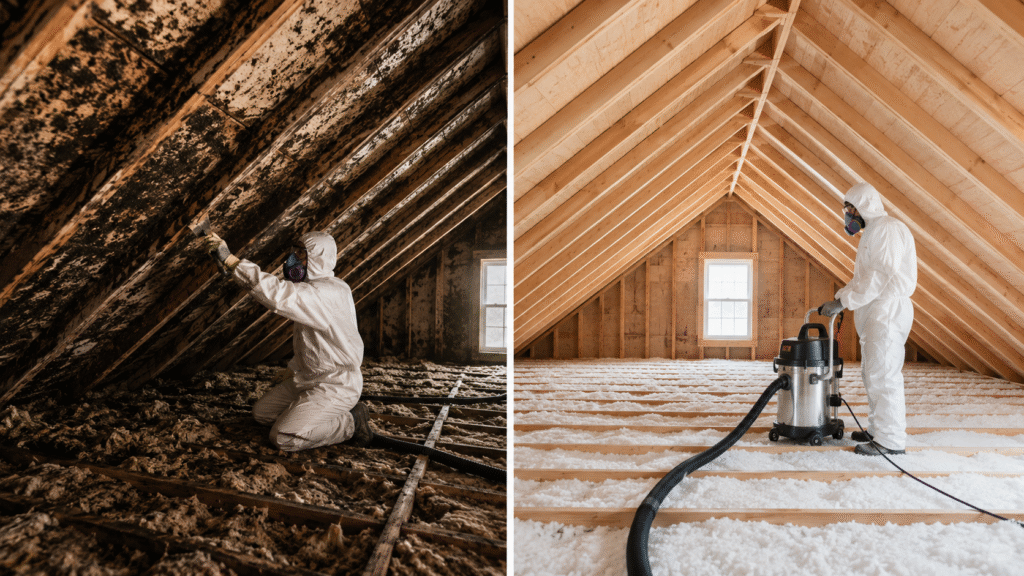
attic mold inspection Jersey City

Can Mold Spread Between Apartments in Jersey City?

QUICK ANSWER: Yes, and in attached Jersey City buildings the cockloft is the usual route. A cockloft may create a single continuous void spanning multiple adjoining occupancies or buildings, so moisture, odour and spores can travel between units above the ceiling line — even where the party walls below are sound. This is why a mold problem in one top-floor apartment often turns out to affect the whole row.

Fire services have understood this about cocklofts for decades, which is why the space is a standard concern in rowhouse firefighting: what enters one cockloft can move along the row. The same geometry applies to moisture.

For a homeowner in an attached building, this has a practical implication. If your neighbour has an unrepaired roof leak and your buildings share a cockloft, your ceiling may be the one that shows the stain. Remediating your side without addressing the source next door will not hold.

EXPERT TIP: For condo boards, co-op boards and HOAs: a shared cockloft usually means the affected area is a common element rather than unit interior, which changes who is responsible for paying. Check your governing documents before individual owners start commissioning their own remediation — it is a common and expensive mistake.

Who Pays for Mold Remediation — Landlord or Tenant?

QUICK ANSWER: In New Jersey, the landlord is normally responsible. New Jersey has no mold-specific statute, but courts recognise an implied warranty of habitability requiring landlords to keep rental units fit for residential use throughout the lease. That duty cannot be waived by a clause in the lease. Where mold arises from a building defect such as a roof leak or absent ventilation, remediation is the landlord’s obligation.

The exception is mold a tenant caused — for example by disabling a bathroom fan, blocking ventilation, or failing to report a leak they knew about. In attic and cockloft cases that exception rarely applies, because tenants have no access to the space and no control over the roof.

How Long Does a Landlord Have to Fix Mold in NJ?

There is no fixed statutory number of days. New Jersey law requires the tenant to give notice and the landlord a reasonable opportunity to repair, with what counts as reasonable depending on severity. The process generally runs as follows:

1.  Notify the landlord in writing. Certified mail with return receipt is the standard advice, because it creates proof of the date notice was given.

2.  Allow reasonable time to repair. Keep a record of what was promised and when.

3.  If nothing is done, tenants in New Jersey may have several remedies — repair and deduct, asking a court to abate or withhold rent, or asking a court to order repairs or compensation.

4.  In serious cases where the unit is genuinely unfit, constructive eviction may apply, which can end the tenant’s obligation for future rent.

SAFETY WARNING: We are a remediation contractor, not a law firm, and nothing here is legal advice. For your specific situation consult an attorney or contact the New Jersey Department of Community Affairs, which publishes guidance on habitability. What we can do is provide the independent written documentation that these processes depend on.

What Both Sides Actually Need: Documentation

Almost every landlord-tenant mold dispute we are asked about comes down to evidence rather than disagreement about the mold itself. An independent inspection with written findings, moisture readings and dated photographs protects both parties. For a landlord, it proves either that there is no problem or that you acted promptly on notice. For a tenant, it converts a complaint into a documented condition.

SituationWhat documentation does
Tenant reports mold, landlord unsureIndependent findings settle whether remediation is genuinely needed
Landlord acted, tenant disputes adequacyPost-remediation verification demonstrates the work achieved its objective
Insurance claimDated moisture readings and photographs are what carriers accept
Habitability proceedingThird-party written report carries weight that either side’s opinion does not
Condo or co-op disputeEstablishes whether the source is common element or unit interior

What an Attic Mold Inspection in Jersey City Should Include

Given that most of these buildings have no walk-in attic, a proper inspection here looks different from a suburban one:

•  Moisture meter readings taken in the actual ceiling and roof structure, not a visual estimate from a doorway.

•  Thermal imaging to locate cold and damp areas behind finished ceilings without demolition.

•  Borescope inspection through a small access point where the cavity cannot otherwise be reached.

•  Assessment of whether any ventilation path exists at all, and what could realistically be created.

•  Roof condition review, since flat roofs are the usual water source in this stock.

•  Tracing of bathroom, kitchen and dryer exhaust to confirm where each terminates.

•  Photographs you keep, whether or not you hire the company.

•  A written scope separating remediation from the moisture correction it depends on.

•  A clear statement of what does not need doing.

Multi-Family and Commercial Mold Remediation in Jersey City

Because Jersey City is overwhelmingly rental and multi-family, a large share of attic and cockloft mold work here is not a single-family job. That changes the requirements:

•  Scheduling around occupied units, with notice periods and access coordination across multiple tenants.

•  Containment planned so that work in one unit does not distribute spores into neighbouring units through the shared cavity.

•  Phased work where the whole row or building cannot be treated at once.

•  Documentation suitable for a managing agent, an insurer, a board or an attorney.

•  Clear separation in the scope between common element and unit interior, so the right party is billed.

•  Coordination with a roofer where the moisture source is the roof rather than the ventilation.

If you manage several buildings in Hudson County, inspections can be scheduled together and reported consistently across the portfolio, which is generally cheaper and considerably easier to act on than commissioning them one at a time.

How Much Does Attic Mold Removal Cost in Jersey City?

Cost varies more in this building stock than in suburban New Jersey, because access is the dominant variable. Six factors set the price:

1.  Affected square footage of ceiling structure or roof deck.

2.  Access. A walk-up attic is straightforward. A sealed cockloft requiring access points to be created is not — this is usually the largest single cost driver in Jersey City.

3.  Whether contaminated insulation must be removed and replaced.

4.  Whether any ventilation can be created, and what that involves in a flat-roofed or attached building.

5.  Whether the roof itself needs attention first.

6.  Whether testing and post-remediation verification are included.

7.  Occupancy. Working around tenants in an occupied multi-family building costs more than an empty single-family attic.

Project pricing is not dictated by the building category alone. Whether you have a single-family attic or a multi-unit complex, the investment depends on the distinct dimensions, intensity, and technical requirements of your mold issue.Several variables drive the final cost: the total square footage of the contaminated structure, the depth of the growth, and how difficult the space is to access. Other drivers include the specific materials involved, the level of containment required to protect the rest of the building, and whether insulation or personal contents must be removed. Most importantly, the price reflects whether a moisture source must be corrected to ensure the fix is permanent.Because every Jersey City property presents unique structural challenges, we do not provide generic estimates or standardized price brackets based on building type. We conduct a thorough evaluation of your specific conditions before any price is determined.
why do old buildings get attic mold

Does Homeowners or Landlord Insurance Cover It?

It depends on the moisture source. Damage from a sudden covered event, such as a storm-damaged roof or a burst pipe, is more likely to be covered. Damage from long-term condensation or deferred maintenance is typically excluded as a maintenance issue. Read the specific policy and speak to the carrier. We can supply the documentation a claim requires, but no contractor can promise you an outcome.

How to Prevent Attic Mold in an Older Building

In a building with limited or no ventilation, prevention works from the inside out — the order matters more here than in a suburban attic, because you often cannot simply add vents.

1.  Air-seal the ceiling plane first. Light fixtures, the roof hatch, plumbing penetrations, wiring holes and wall top plates. In a sealed cockloft this is the primary defence, because if moisture cannot get up there, it cannot condense.

2.  Fix exhaust termination. Every bathroom, kitchen and dryer duct must discharge outside the building, not into the cavity and not at a soffit where it is drawn straight back in.

3.  Manage indoor humidity. Run bathroom fans during and after showers, and use a dehumidifier on the top floor during humid months.

4.  Maintain the roof. Flat roofs need inspection at least annually, and after any significant storm. Most cockloft moisture in this stock arrives through the roof.

5.  Create ventilation where the structure allows. Sometimes possible during a roof replacement. Frequently it is not, which is why steps 1 and 2 carry more weight here.

6.  Inspect after any roof work. A repaired leak does not undo what the water already did above the ceiling.

When to Call a Professional in Jersey City

Treat It as Urgent If

•  Anyone in the household has asthma, allergies or a compromised immune system.

•  The ceiling is soft, sagging or actively wet.

•  Multiple units in the building report the same smell — that indicates a shared cavity.

•  You are buying, selling or in a habitability dispute.

•  A roof leak has occurred and nobody has assessed what happened above the ceiling.

You Have Time to Plan If

•  The staining is limited, dry and stable.

•  Nobody in the building has respiratory symptoms.

•  There is no active leak.

•  You are not transacting or in dispute.

•  In that case, get the inspection, understand the scope, and schedule the work when it suits your budget.

Important: New Jersey Does Not License Mold Contractors

Every New Jersey property owner should know this, and few contractors will tell you. New Jersey does not license mold assessors or remediators at state level — as of 2026 only Florida, Texas, New York and Washington DC license both. Anyone here can call themselves a mold company with no state credential.

Since there is no licence to check, verify these instead:

1.  New Jersey Home Improvement Contractor registration, verifiable free through the NJ Division of Consumer Affairs. Ask for the number and look it up.

2.  General liability insurance and specifically pollution liability, since standard policies often exclude mold work. Ask to see the certificate.

3.  Third-party certification such as IICRC, ACAC or NORMI. These are voluntary in New Jersey, which is exactly why they mean something.

4.  References from work in buildings like yours — attached, multi-family, flat-roofed — not just suburban attics.

Why Choose MMRG for Attic Mold Removal in Jersey City

•  We inspect before we quote. No price is given over the phone for a building nobody has looked at.

•  We identify what you actually have — attic, cockloft or flat roof cavity — and scope accordingly.

•  We correct the moisture source. Remediation without it is temporary by definition.

•  We provide written documentation suitable for landlords, tenants, boards, insurers and attorneys.

•  We tell you when remediation is not needed, and a meaningful share of our free inspections end that way.

•  Licensed inspectors carry out the assessment, not commissioned salespeople.

•  New Jersey-registered Home Improvement Contractor, HIC #13VH07910200, fully insured.

IAQA & ESA certified. MMRG began operating in New Jersey in 2012.

Book a Free Attic Mold Inspection in Jersey City

If there is a musty smell on your top floor, staining on the ceiling, or a roof leak nobody has followed up on, the inspection costs nothing. You get moisture readings, photographs you keep, and a written answer about whether remediation is needed.

If it turns out you do not need us, we will tell you that and leave.

See our attic black mold removal service →

Or call 908-601-1307 to book. We serve Jersey City, Hudson County and most of New Jersey.
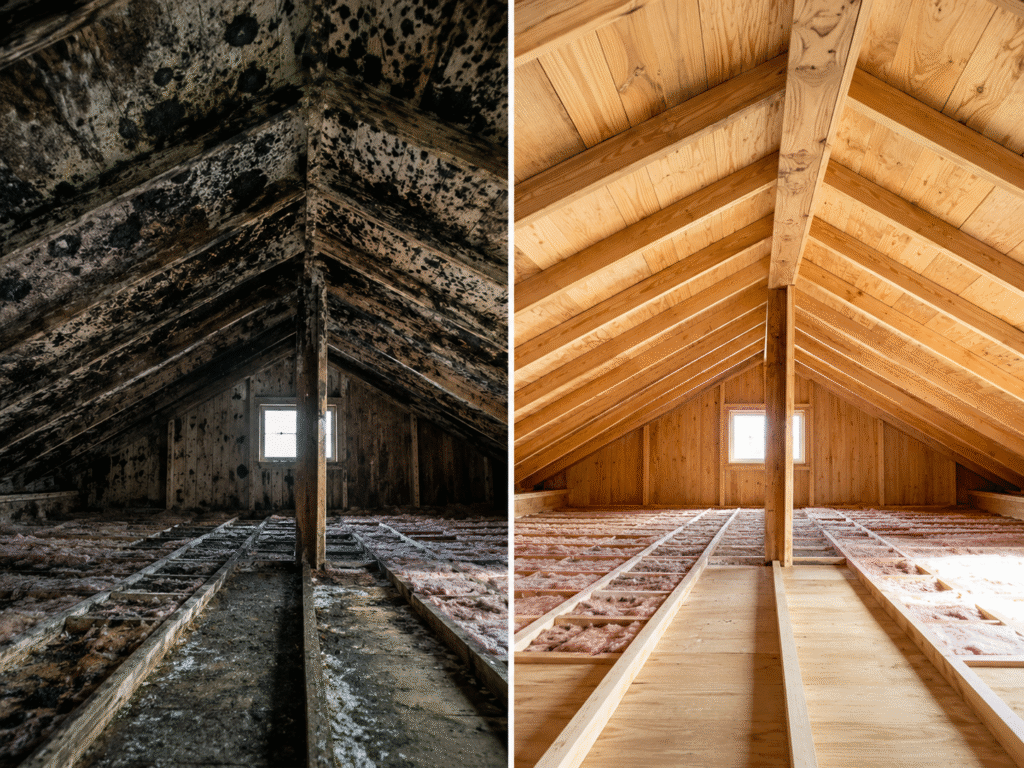
Is Black Mold in Your Attic Dangerous? What NJ Homeowners Should Know

QUICK ANSWER: Black mold in your attic is almost certainly less dangerous than you have been led to believe. The CDC states that Stachybotrys chartarum — the species behind the “toxic black mold” label — has never been proven to cause the severe illnesses commonly attributed to it, and should be treated like any other household mold. It still needs to come out, but the reason has far more to do with moisture damage and indoor air quality than with toxicity.

If you found this page at eleven at night after seeing something dark across your roof sheathing, take a breath. That reaction is completely normal, and the internet is not helping. Search “black mold” and you will find page after page describing memory loss, bleeding lungs and toxic poisoning. Most of that content was written to sell remediation, and most of it does not reflect what health authorities actually say.

We remediate attic mold across Monmouth County every week, and we would rather tell you the truth than frighten you into a phone call. This guide covers what black mold actually is, what the evidence supports about health risk, how to identify what you are looking at, when it is genuinely urgent, what removal costs, and how to decide whether you need anyone at all.

Is Black Mold Dangerous? The Honest Answer

“Black Mold” Is Not Actually a Species

This is the first thing worth understanding, because it dissolves a lot of the anxiety on its own. There is no organism called black mold. It is a popular term, not a scientific one, and the CDC has stated plainly that “toxic mold” is not an accurate description either.

Dozens of mold genera appear black. Cladosporium, Alternaria and Aspergillus niger are all common in New Jersey homes, all frequently dark in colour, and none of them are what people mean when they say black mold. The species people are actually picturing is Stachybotrys chartarum — and it is considerably less common in attics than it is in chronically saturated drywall, paper-faced insulation and water-damaged cellulose materials.

DEFINITION: Stachybotrys chartarum: a greenish-black mold that requires prolonged, sustained moisture on cellulose-rich material to establish. In our experience, it is far more likely to be found behind a wall that has been wet for months than on attic sheathing exposed to seasonal condensation.

What the CDC Actually Says About Stachybotrys

We would encourage you to read the CDC’s own page rather than take our word for it, but here is the substance of it:

•  No test exists that proves an association between Stachybotrys chartarum and particular health symptoms.

•  The suspected link between Stachybotrys and acute idiopathic pulmonary haemorrhage in infants — the cluster of cases that generated the entire toxic-mold panic — has never been proven.

•  The CDC’s position is that Stachybotrys chartarum should be treated the same as any other household mold, not as a separate emergency category.

That is a remarkable thing to find on a mold remediation company’s website, and we are aware of it. But we would rather you trust us on the small claims so you trust us on the large ones.

Toxigenic Versus Toxic: The Distinction That Changes Everything

Almost every scare article online collapses these two words, and the collapse is what creates the fear.

DEFINITION: Toxigenic means a mold is capable of producing mycotoxins under certain conditions. Toxic would mean the mold itself is poisonous. Molds are the former, not the latter — the CDC draws this distinction explicitly.

The practical detail matters too. Only around a third of Stachybotrys chartarum strains produce trichothecene mycotoxins at all, and whether they do depends on the substrate and the environmental conditions. Finding the mold does not mean mycotoxins are present. And the EPA classifies mold as an allergen, not a toxin.

Where the Toxic Black Mold Panic Came From

Understanding the origin of a belief is usually more convincing than being told it is wrong. In the 1990s, a cluster of infant pulmonary haemorrhage cases in Cleveland was tentatively linked to Stachybotrys exposure. The story was covered widely, a wave of litigation followed, and “toxic black mold” entered the language permanently.

Subsequent review found the causal link unproven. But by then the term had escaped into public consciousness, and an entire industry had discovered it was extremely good for business. Thirty years later the fear is still doing commercial work, long after the science stopped supporting it.

Black Mold vs Regular Mold: Does the Colour Matter?

Short answer: no. Colour comes from species, pigmentation and the surface the mold is growing on. It tells you almost nothing about risk.

QuestionBlack Mold (Stachybotrys)Other Common Attic Molds
How common in NJ atticsUncommon — needs sustained saturationVery common — Cladosporium and Aspergillus dominate
AppearanceDark greenish-black, often slimy when wetBlack, grey, green, white or brown
What it needs to growProlonged water on cellulose-rich materialFar less — seasonal condensation is enough
Proven distinct health riskNot proven distinct from other molds (CDC)Allergenic and irritant effects documented
How we remediate itIdentical processIdentical process
black mold in attic

That final row is the point of the whole table. The remediation procedure does not change based on species. This is why paying for a species identification before remediation rarely makes financial sense, and it is why a company quoting you extra because you said the words “black mold” is charging you for a word rather than for work.

What Actually Determines Your Risk

Replace colour with these four factors, and you will assess your own situation more accurately than most articles will let you:

1.  How much growth there is.

2.  Whether spores are becoming airborne and circulating into your living space.

3.  How long it has been growing.

4.  Whether anyone in the household has asthma, allergies, or a compromised immune system.

Black Mold Attic Health Risks: What Is Actually Documented

Black Mold Symptoms Supported by Evidence

Mold exposure generally — not black mold specifically — is associated with:

•  Nasal and sinus congestion.

•  Throat irritation, coughing and wheezing.

•  Eye irritation.

•  Worsening of existing asthma.

•  Allergic reactions in people already sensitised to mold.

These are real and worth taking seriously. They are also a considerably different list from the one circulating in the more alarming corners of the internet.

Who Is Genuinely at Higher Risk

•  People with asthma or diagnosed mold allergies.

•  Immunocompromised individuals, including anyone on immunosuppressive therapy.

•  Infants and young children.

•  Older adults.

•  Anyone with a chronic respiratory condition such as COPD.

If someone in your household is on this list, move faster than you otherwise would. If nobody is, you have more time to plan than the internet suggested.

Is Attic Mold a Health Hazard If It Stays in the Attic?

This is the most common reason homeowners in Middletown, Holmdel and Marlboro Township tell us they left it for three years. It is also the one misconception on this page that we will push back on hard, because it is genuinely wrong.

Your attic is not sealed off from your living space. Warm air rises and exits the upper part of the house, drawing replacement air in below — the stack effect — and attic air is part of that circulation. Spores from attic growth reach the bedrooms underneath. This is the honest argument for dealing with attic mold, and it is far stronger than any toxicity claim, because it is actually true.

What the Evidence Does Not Support

We think naming these specifically is more useful than gesturing vaguely at misinformation:

•  Memory loss, cognitive decline or neurological damage from ordinary residential attic exposure.

•  Bleeding lungs in infants — the claim that started the panic, never proven.

•  The idea that a black colour indicates a more dangerous mold.

•  The idea that mold in a home constitutes a medical emergency requiring you to leave the house.

Identifying Black Mold in Your Attic

Black Mold on Attic Wood: What You Are Looking At

On plywood sheathing, attic mold typically shows as dark grey or black surface growth with visible texture. On OSB, it often appears first as darkening along the edges of the wood strands before spreading across the face.

Look at the pattern. If the growth runs in vertical streaks between the rafters and along the nail lines, and it is worst on the north-facing slope, you are looking at condensation mold — by far the most common finding in New Jersey attics. That pattern tells you the cause before any test does. We cover the mechanism in detail in our guide to what causes attic mold in NJ homes, so we will not repeat it here.

EXPERT TIP: Reassurance worth having: surface growth on sheathing is generally not a structural problem in its early stages. It is growing on the wood, not consuming it. Structural damage comes from wood decay fungi, a different organism entirely. If your sheathing is discoloured but still firm when you press it, you are almost certainly looking at surface mold rather than rot.
roof leak mold damage

Four Things Commonly Mistaken for Black Mold

1.  Soot or creosote staining, usually near a chimney chase.

2.  Historic water staining — flat, dry, stable, with no texture. It marks where a problem used to be.

3.  Blue stain fungus, which was in the lumber before it was ever installed and causes no ongoing harm.

4.  Wood decay fungi, which is more serious than mold and needs structural assessment rather than remediation.

A practical field test: mold has texture and usually some colour variation across the growth. A stain is flat and uniform. Brush it lightly with a gloved finger — if material lifts, it is biological. If nothing lifts and the surface stays smooth, it is likely a stain.

Checklist: A Safe DIY Attic Check

1.  Pick a cold morning. Condensation problems are visible in winter and effectively invisible in July.

2.  Bring a bright flashlight and wear an N95 respirator.

3.  Check the north-facing slope first.

4.  Look along the nail lines and between the rafters for vertical streaking.

5.  Check the nail tips for frost or beaded moisture.

6.  Confirm the soffit vents at the eaves are clear and not buried in insulation.

7.  Photograph anything questionable rather than touching it.

8.  Come back down without cleaning anything.

SAFETY WARNING: Never walk between the joists — attic floors are frequently just drywall, and you will come through the ceiling. Always wear an N95 or better before entering. Do not disturb, scrape or brush suspected growth without proper containment; that is precisely what puts spores into the air you breathe downstairs. If you have asthma, a respiratory condition, or a compromised immune system, do not go into the attic at all — send someone else or call a professional.

Should I Worry About Attic Mold? A Straightforward Framework

Most articles on this topic answer this question with “yes, call immediately.” Here is a more useful answer.

Treat It as Urgent If:

•  Anyone in the household has asthma, allergies, or is immunocompromised.

•  The growth covers more than roughly 10 square feet.

•  The sheathing feels soft or delaminated when pressed — that indicates decay, not surface mold.

•  You are under contract to buy or sell the property.

•  You can smell it from inside the living space.

You Have Time to Plan If:

•  The growth is limited and confined to the surface of the sheathing.

•  Nobody in the house is experiencing respiratory symptoms.

•  There is no active roof leak.

•  You are not transacting on the property.

In that second scenario it is entirely reasonable to get an inspection, understand the scope, and schedule the work for a month that suits you and your budget. We would rather tell you that than pressure you into an emergency you are not actually having.

The Four Real Reasons to Remove It Anyway

1.  Indoor air quality. The stack effect means attic air reaches your living space, whether or not anyone currently feels it.

2.  Moisture damage. The mold is a symptom. The underlying condensation is degrading your insulation’s performance and, over years, the sheathing itself.

3.  Property transactions. It will be found at inspection, and unresolved findings routinely cost more in buyer concessions than the remediation would have.

4.  It does not resolve itself. Every winter the same cycle repeats and the affected area grows.

Notice that none of those four reasons is toxicity. That is deliberate, and it is the honest case for doing the work.

Attic Mold Testing in NJ: When It Is Worth Paying For

When Testing Changes the Outcome

•  You need documentation for a real estate transaction or an insurance claim.

•  Someone has unexplained respiratory symptoms and the source has not been located.

•  There is a dispute — landlord and tenant, or buyer and seller.

•  You want post-remediation verification that the work achieved what it was supposed to.

When Testing Does Not Change Anything

If you can see the growth and you already know it needs to come out, identifying the species will not alter the remediation procedure or the price. Some companies sell testing on every job because it is profitable. We recommend it when it is useful and tell you when it is not, which is more often than you might expect.

What a Proper Test Involves

1.  Air sampling with a calibrated pump drawing a measured volume of air over a known period.

2.  A simultaneous outdoor control sample taken the same day — without it, indoor spore counts mean nothing, because outdoor air always contains mold.

3.  Analysis by an accredited independent laboratory, not by the company selling you the remediation.

4.  A walkthrough of the results with you, line by line, rather than an emailed PDF and silence.

EXPERT TIP: A word on DIY petri-dish kits: something grows in almost every home, because mold spores exist in the air of every building on earth. Without an outdoor control sample there is no baseline, and a positive result carries no information about whether your home is abnormal. If you have already bought one and been alarmed by the result, bring it up when you call and we will tell you honestly what it does and does not show.
attic mold roof repair NJ

How to Remove Black Mold in the Attic: The Professional Process

Proper attic black mold removal follows a defined order, and the order matters as much as the individual steps.

1.  Inspection and moisture mapping, with meter readings taken in the sheathing itself.

2.  Identify and correct the moisture source. This comes before remediation, not after.

3.  Set up containment and negative air pressure so spores are not distributed into the living space during the work.

4.  Remove the growth and apply an antimicrobial.

5.  Remove and replace contaminated insulation — it is porous throughout and cannot be effectively treated.

6.  Correct the ventilation and air-seal the ceiling plane.

7.  Verify the result, with post-remediation testing where the situation warrants it.

EXPERT TIP: Step 2 is where most failed remediations go wrong. Cleaning an attic before correcting ventilation, air leakage or an active roof leak guarantees the mold returns. If a company quotes you for cleaning without discussing why the mold grew, they are selling you the same job twice.

Why DIY Black Mold Removal in an Attic Usually Fails

•  Bleach is roughly 94% water. On porous wood the chlorine stays on the surface while the water soaks in and feeds the growth underneath. This is the single most common client mistake we encounter.

•  Scraping or sanding without containment aerosolises spores straight into the house below, through the same stack effect described earlier.

•  Cleaning without correcting ventilation means the growth returns within two or three winters.

•  Attics are genuinely hazardous work environments — heat, poor footing, limited egress and no easy way out if something goes wrong.

Five Red Flags in a Black Mold Quote

1.  A price given over the phone with nobody inspecting the attic.

2.  Encapsulation proposed with no mention of ventilation or air sealing.

3.  “Toxic mold” language used to justify a premium price.

4.  The same company performing both the testing and the remediation, with no independent laboratory involved.

5.  Pressure to sign the same day, or a discount that expires that afternoon.

Black Mold Removal Cost in New Jersey

What Actually Drives the Price

1.  The square footage of affected sheathing.

2.  Attic access. A walk-up staircase with standing headroom is a completely different job from a small hatch with three feet of clearance.

3.  Whether contaminated insulation has to be removed and replaced.

4.  How much ventilation correction and air sealing the attic needs.

5.  Whether testing is included in the scope.

Does “Black Mold” Cost More to Remove Than Other Mold?

No. The remediation procedure is identical regardless of species, so the price should be identical too.

We are telling you this because it is the most common way homeowners get overcharged on this particular service. A homeowner calls, says the words “black mold,” and the quote comes back higher than it would have if they had said “attic mold” — for work that is exactly the same. You have no way to know it happened.

EXPERT TIP: Ask every company you call this question directly: “Would this quote be different if I had described it as regular attic mold instead of black mold?” The answer, and how comfortable they are giving it, will tell you a great deal about who you are dealing with.

Keeping Black Mold From Coming Back

Prevention comes down to one principle applied in the right order: seal the ceiling plane first, then correct the ventilation, then insulate. Doing it in any other sequence is why so many attics get “fixed” more than once.

•  Check for frost on the nail tips on a cold winter morning. It is the earliest warning available to a homeowner and it costs nothing.

•  Confirm bathroom and dryer exhaust terminate outside the building, not in the attic.

•  Keep insulation clear of the soffit vents using baffles.

•  Inspect in autumn, before the heat comes on for the season.

For the full explanation of why attic mold forms in New Jersey homes and how to stop it permanently, see our detailed guide on what causes attic mold in NJ homes.

Black Mold Inspection Across Monmouth County and Nearby NJ Towns

What we find in an attic depends a great deal on where in New Jersey that attic is.

Shore Communities: Monmouth Beach, Long Branch, Deal, Atlantic Highlands, Belford, Union Beach and Seaside Heights

These towns share elevated year-round humidity and a quieter problem most homeowners never consider: salt air gradually corrodes vent hardware, so soffit screens and ridge vent baffles clog and close off over the years without anyone touching them. There is also a high proportion of seasonal properties standing closed and unconditioned from October through May.

That last point matters for this article specifically. A property sealed for seven months with no air movement is one of the few situations in New Jersey where sustained-moisture species genuinely become plausible. If you close a shore property for the season, the attic is worth a look before you lock up rather than after you return.

Inland Monmouth County: Holmdel, Colts Neck, Marlboro Township, Middletown, Tinton Falls, Little Silver, Rumson, Oceanport and Eatontown

Homes here tend to be larger with more complicated roof geometry — multiple dormers, valleys, hips and cathedral sections. That complexity creates dead-air pockets that standard soffit-and-ridge ventilation never reaches, and growth appears in those pockets while the rest of the attic looks perfectly fine. These towns also have a high rate of insulation retrofits that buried the soffit intake without baffles, which is one of the most common self-inflicted causes we see.

North and Central New Jersey: Edison and Jersey City

Older and denser housing stock, more attached and semi-detached construction with limited gable access, and a significant number of attics converted to living or storage space with no redesign of the ventilation. Converted attics are a particular concern, because insulating a roofline without leaving a ventilation channel above the insulation removes the drying capacity entirely. These towns sit outside our Monmouth County core, but the building patterns are consistent enough that the diagnosis is usually straightforward.

When to Call a Professional in New Jersey

Use the urgency framework above to decide when. Use this section to decide who.

What a Proper Attic Inspection Should Include

•  Moisture meter readings taken in the sheathing itself, not a visual estimate from the hatch.

•  Assessment of the attic’s ventilation against code requirements.

•  Tracing of every exhaust duct to its termination point.

•  Photographs you keep, whether or not you hire the company.

•  A written scope that separates remediation from moisture correction.

•  An explicit statement of what does not need doing.

Important: New Jersey Does Not License Mold Contractors

Every New Jersey homeowner should know this before hiring anyone, and very few contractors will volunteer it.

New Jersey does not license mold assessors or mold remediators at state level. As of 2026, only Florida, Texas, New York and Washington DC license both. In practice, that means anyone in this state can print business cards tomorrow and call themselves a mold company, with no state credential required at all.

Since there is no licence to verify, here is what to check instead:

1.  New Jersey Home Improvement Contractor registration. It is required, and you can verify it free through the NJ Division of Consumer Affairs. Ask for the number and look it up.

2.  General liability insurance and, specifically, pollution liability coverage. Standard liability policies frequently exclude mold work entirely. Ask to see the certificate.

3.  Third-party certification through a recognised body such as the IICRC, ACAC or NORMI. These are voluntary in New Jersey — which is exactly why they mean something.

4.  References from completed work in your own town, not a testimonials page.

Why Choose MMRG for Attic Black Mold Removal in New Jersey

It is more useful to tell you what we will not do.

•  We will not charge a premium because you used the words “black mold.” The process is the same, so our price is the same.

•  We will not use “toxic mold” language to make a job sound more urgent than it is. If this whole article has a thesis, that is it.

•  We will not quote attic black mold removal without inspecting the attic first.

•  We will not use dry ice blasting as a substitute for correcting the moisture source. It is faster and easier for us, and it does not solve the problem.

•  We will not quote remediation you do not need. A meaningful share of our free inspections end with us telling a homeowner the staining is historic and nothing needs doing.

•  We will not send a commissioned salesperson to your kitchen table. The person who inspects your attic is an inspector.

MMRG is a New Jersey-registered Home Improvement Contractor, HIC #13VH07910200, fully insured, based at 1 Griffin Pl in Ocean Township. We serve Monmouth County and most of New Jersey, and we will give you references from work in your own area before you commit to anything at all.

Get a Free Attic Black Mold Inspection Anywhere in New Jersey

If you have seen dark staining on your roof sheathing and you are not sure what you are looking at, we will come and tell you. Free, on site, about thirty minutes. You get moisture readings, photographs you keep, and a straight answer.

And if it turns out you do not need remediation, we will say so and leave.

Learn more about our attic black mold removal service in New Jersey →

Or call 908-601-1307 to book your free attic inspection.

Frequently Asked Questions About Black Mold in NJ Attics

Is black mold in my attic dangerous to my family?

Far less than most websites claim — the CDC states Stachybotrys has never been proven to cause the severe illnesses attributed to it, though allergic and respiratory symptoms are real, particularly for asthma sufferers.

How can I tell if it is toxic black mold?

You cannot tell by looking, because colour does not indicate toxicity and dozens of common molds appear black.

Does black mold cost more to remove than regular mold?

No, because the remediation procedure is identical regardless of species, so be cautious of any quote that rises after you use the words “black mold.”

Is attic mold a health hazard if it stays in the attic?

Yes, because the stack effect draws attic air down into your living space, so attic mold does not stay in the attic.

Should I worry about attic mold if nobody feels sick?

You can reasonably plan rather than panic if the growth is limited and nobody has respiratory conditions, but it still needs addressing because it worsens every winter.

Does New Jersey require a licence for black mold remediation?

No — New Jersey licenses neither mold assessors nor remediators, so verify Home Improvement Contractor registration, pollution liability insurance and IICRC or ACAC certification instead.

Do you inspect for black mold outside Monmouth County?

Yes, we handle attic black mold inspection and remediation across most of New Jersey, including Edison and Jersey City, from our base in Ocean Township.

What Causes Attic Mold in NJ Homes (and How to Stop It for Good)

Attic mold in New Jersey homes is most commonly caused by poor ventilation, bathroom exhaust fans venting directly into the attic, roof leaks, and condensation buildup — and it can spread across your entire roof deck in a matter of weeks. NJ’s humid coastal climate, especially in Monmouth County communities like Rumson, Long Branch, and Middletown, creates year-round moisture conditions that make attics uniquely vulnerable. The good news is that once you understand the cause, attic mold can be stopped permanently — but only if it’s treated correctly and the moisture source is eliminated at the same time.

If you’ve climbed into your attic and noticed dark staining on the plywood, a musty odor on your upper floor, or unexplained black spots on your roof sheathing, you’re not alone. We receive calls every week from New Jersey homeowners across Holmdel, Tinton Falls, Edison, and Jersey City who have discovered attic mold that’s been silently spreading for months — sometimes years — without a single visible sign from inside the home.

This guide covers everything you need to know: what causes attic mold, how to identify it, what professional remediation involves, what it costs in NJ, and how to keep it from coming back. If you’re ready to get a professional opinion now, you can learn more about our attic mold removal services in New Jersey.


What Is Attic Mold — and Why Are NJ Homes So Vulnerable?

Attic mold is fungal growth that develops on wood surfaces inside your attic — most commonly on roof sheathing (the plywood or OSB panels attached to your rafters), but also on rafters, ridge boards, insulation, and collar ties. It thrives wherever wood stays damp and airflow is limited.

Mold spores are present in every home. The difference between a clean attic and a moldy one is simple: moisture and time. Give mold spores a consistently damp surface and temperatures above 40°F, and colonies can establish themselves in as little as 24 to 48 hours.

What Attic Mold Looks Like

Knowing what you’re looking for is the first step. Attic mold typically appears as:

  • Black spots or streaks on roof sheathing — the most common presentation; often confused with dirt or aging wood
  • Green or gray fuzzy patches on rafters or ridge boards
  • White powdery growth — early-stage colonies, sometimes mistaken for mineral deposits or sawdust
  • Dark staining that fans outward from a central point, often near a blocked vent or exhaust duct termination

Attic mold on plywood is especially common in New Jersey homes because plywood is porous and retains moisture longer than solid lumber. Once mold penetrates the surface fibers of plywood sheathing, surface treatment alone won’t eliminate it — mechanical removal is required.

Why New Jersey Homes Are Especially at Risk

New Jersey’s climate creates a perfect storm of attic mold conditions. Summers are hot and humid, with average relative humidity regularly exceeding 70% — the threshold at which mold colonies accelerate in growth. Winters bring cold temperatures that cause warm interior air to condense on cold attic surfaces. And coastal communities from Monmouth Beach to Deal and Oceanport contend with salt-laden sea air that increases moisture absorption in wood.

On top of that, New Jersey has a significant stock of older homes — many built in the 1950s through 1980s — with ventilation systems designed for a different era, and bathroom exhaust fans that were routinely ducted into attic spaces rather than directly outside. That combination of climate, age, and construction practice makes attic mold one of the most common home problems we deal with across the state.


The 7 Most Common Causes of Attic Mold in NJ Homes

1. Poor or Blocked Attic Ventilation

This is the single most common cause of attic mold we see in New Jersey — and it’s almost always fixable. A properly ventilated attic maintains continuous airflow from soffit vents at the eaves to ridge or gable vents at the peak, flushing warm, moist air out before it can condense on cold wood surfaces.

When ventilation fails — because soffit vents are buried under insulation, ridge vents are clogged with debris, or the ventilation system was never adequately designed — moisture gets trapped and mold follows. New Jersey building code (NJAC 5:23) requires a minimum of 1 square foot of net free ventilation area for every 150 square feet of attic floor space. Many older homes in Colts Neck, Holmdel, and Middletown were built before these standards were strictly enforced, and some have never been updated.

Signs your ventilation is failing:

  • Your upper floors are unusually hot in summer
  • Ice dams form along your roofline each winter
  • The attic feels stuffy or humid even in cold weather
  • You can see dark staining concentrated near the ridge or along exterior walls

2. Bathroom or Kitchen Exhaust Fans Venting Into the Attic

If I had to pick the single most preventable cause of attic mold we encounter in NJ homes, this would be it. Exhaust fans are designed to move warm, moisture-laden air out of your home entirely. When a contractor — or a well-meaning DIYer — terminates that duct inside the attic instead of routing it through to the exterior, every hot shower, every stovetop boil, every load of laundry dumps humid air directly onto cold attic surfaces.

We inspected a home in Tinton Falls where a single second-floor bathroom fan had been venting into the attic for approximately six years. By the time the homeowner noticed a musty smell in the upstairs hallway, black mold covered more than 400 square feet of roof sheathing — the entire north-facing roof deck. The remediation cost more than $7,000, plus $1,200 to properly reroute the exhaust duct to a roof cap. The original ducting error would have cost less than $200 to do correctly.

This is extremely common in older homes throughout Edison, Jersey City, Middletown, and Eatontown — communities with significant housing stock from the 1960s and 70s when this practice was standard.

3. Roof Leaks

A leaking roof introduces liquid water into your attic — the fastest path to mold growth. Missing or cracked shingles, failed flashing around chimneys and skylights, deteriorated pipe boots, and compromised ice-and-water shield along the eaves can all allow water to infiltrate the attic cavity.

The tricky thing about roof leak mold is that the visible water stain on your ceiling and the mold growth in your attic are often not directly above each other. Water travels along rafters and roof decking before it drips, which means a flashing failure at a chimney can cause mold on plywood ten feet away from where the water actually enters.

New Jersey’s nor’easters are a particularly frequent culprit. We routinely receive calls in late winter and spring from homeowners in Rumson, Monmouth Beach, and Long Branch whose roofs sustained storm damage they weren’t aware of until mold showed up weeks later.

Professional advice: If your home has experienced any roof leak, ice dam, or significant storm damage — even if the roof has since been repaired — schedule an attic inspection within 30 days. Mold doesn’t wait for a convenient time to grow.

4. Attic Condensation

Attic condensation mold is a subtler problem than a roof leak, but it’s just as damaging. It occurs when warm, humid air from your living space rises into the attic and contacts cold roof sheathing — the same physics that cause a cold glass to “sweat” on a warm day.

In New Jersey, this typically intensifies in late fall and early winter. As homeowners crank up the heat, warm air rises through ceiling light fixtures, plumbing chases, attic hatches, and partition top plates — any gap in the attic floor is an entry point. Once that warm air hits cold roof decking, it condenses and keeps the wood perpetually damp.

Older homes in Little Silver, Oceanport, and Colts Neck with minimal air sealing are particularly prone to this. Ice dam formation along the roofline is one of the clearest indicators that warm air is escaping into the attic — it signals that the attic floor is not adequately sealed or insulated.

5. Improperly Installed Insulation

Insulation errors are a surprisingly common contributor to attic mold in NJ homes. The two most frequent mistakes we see:

  • Insulation blown directly over soffit vents, blocking the airflow intake that the entire ventilation system depends on. Without baffles or rafter vents to maintain an air channel, the soffit is essentially sealed shut.
  • Kraft-faced insulation installed with the vapor barrier facing the wrong direction, trapping moisture in the wrong layer and holding it against wood surfaces.

Both errors are inexpensive to correct before they cause mold. After they’ve caused mold, the cost is considerably higher.

6. HVAC Equipment and Leaky Ductwork in the Attic

Homes with air handlers or duct systems routed through the attic — common in larger homes throughout Holmdel, Colts Neck, and parts of Middletown — face an additional moisture risk. Leaky duct connections release conditioned air (which can be very humid in summer) directly into the attic. Condensate drain lines from attic air handlers that are improperly routed or clogged can drip water onto the attic floor and insulation below. The result is localized but aggressive mold growth concentrated around HVAC equipment.

7. Whole-Home Moisture Problems

Attic mold is always a symptom of a moisture problem somewhere — and that problem isn’t always in the attic itself. Homes with wet basements, crawl spaces, or persistent indoor humidity issues can develop attic mold through the “stack effect”: air pressure differences that push ground-level moisture upward through the home and into the attic.

We see this frequently in Jersey City row homes, attached townhomes in Edison, and older colonial-style homes in Middletown where crawl spaces are unencapsulated. Treating the attic mold without addressing the source-level moisture is like mopping up a floor while the faucet is still running.


Signs of Attic Mold: What to Look and Listen For

You don’t need to climb into your attic to suspect you have a mold problem. Here are the most common signals:

Visual signs (inside the attic):

  • Black, green, or gray spots or patches on roof sheathing, rafters, or plywood
  • Dark staining that radiates from vents, exhaust terminations, or nail penetrations
  • White powdery patches on wood surfaces (early-stage colonies)
  • Wet or compressed insulation in any area of the attic floor

Non-visual signals (from inside your home):

  • A musty or earthy smell on the second floor or in upstairs closets
  • Peeling or bubbling paint on ceilings directly below the attic
  • Family members experiencing unexplained respiratory symptoms, chronic coughing, or worsening asthma
  • Higher-than-normal energy bills (poor attic conditions force your HVAC to work harder)
  • Ice dams forming along your roofline in January and February

Attic Mold Health Risks You Shouldn’t Ignore

Attic mold is not just a structural problem — it’s a health concern. Mold spores migrate from the attic into living spaces through recessed light fixtures, attic hatches, and ceiling penetrations. Once airborne, they can trigger respiratory irritation, allergic reactions, eye and skin irritation, and persistent sinus problems.

Children, elderly family members, and anyone with asthma, allergies, or a compromised immune system are particularly vulnerable. If members of your household are experiencing unexplained symptoms that improve when they leave home, that’s a strong indicator that your indoor air quality may be affected by attic mold.

Attic Mold Treatment: What Professional Remediation Involves

Can You Remove Attic Mold Yourself?

The short answer: for small, isolated surface mold on non-porous materials, limited DIY treatment is possible with proper protective equipment and EPA-registered fungicide. For any mold on wood sheathing, rafters, or plywood — which is essentially every attic mold situation we encounter in NJ — professional remediation is strongly recommended.

Here’s why DIY almost always falls short:

  • Bleach does not kill mold on porous wood surfaces. It removes the color but leaves the mold’s root structure (mycelium) alive and intact. The mold will return within weeks.
  • Without containment, you spread spores. Disturbing mold colonies without professional-grade HEPA containment and negative air pressure systems releases billions of spores into your living space.
  • Without fixing the source, mold comes back. The most common call we receive from homeowners who attempted DIY treatment is “the mold came back even worse.” This happens when the moisture source — the ventilation problem, the rerouted fan, the roof leak — is never addressed.

The Professional Attic Mold Remediation Process

When our certified team arrives at a home in Monmouth County or elsewhere in New Jersey, here’s what the process looks like:

  1. Inspection and moisture testing — We use moisture meters and thermal imaging to identify the full scope of the mold and locate the moisture source driving it.
  2. Containment setup — We establish negative air pressure within the attic using commercial air scrubbers and poly barriers to prevent cross-contamination to living spaces.
  3. HEPA vacuuming — All loose mold spores are vacuumed from surfaces before any physical treatment begins.
  4. Mechanical removal — Mold is physically removed from wood surfaces using dry ice blasting, soda blasting, or hand scrubbing with wire brushes, depending on the severity and surface type.
  5. Antimicrobial treatment — All treated surfaces are coated with an EPA-registered antimicrobial solution to kill remaining spores and inhibit regrowth.
  6. Encapsulation — A mold-resistant encapsulant is applied to seal the treated wood and provide a lasting protective barrier.
  7. Source correction — We repair or coordinate repair of the moisture source: rerouting exhaust fans, adding ventilation, addressing roof leaks.
  8. Post-remediation clearance testing — An independent third-party air quality firm conducts air sampling to confirm the attic meets clearance standards before we close the project.
  9. Documentation — We provide a full written report, suitable for insurance claims and real estate transactions, documenting the work performed and the clearance results.

How Much Does Attic Mold Removal Cost in NJ?

Attic mold removal in New Jersey typically costs between $1,500 and $6,000 for most residential projects. Larger attics with extensive contamination or structural repairs required can reach $8,000 to $15,000 or more.

Here’s a general breakdown by project scope:

Project ScopeTypical Cost Range
Small isolated spot (under 10 sq. ft.)$500 – $1,500
Moderate coverage (10–100 sq. ft.)$1,500 – $4,000
Extensive coverage (100–500 sq. ft.)$4,000 – $8,000
Full attic remediation (500+ sq. ft.)$8,000 – $15,000+
Roof deck board replacement (if needed)Add $3,000 – $10,000
Ventilation repair / exhaust fan reroutingAdd $500 – $2,500
Post-remediation clearance air testing$300 – $500

Does Homeowner’s Insurance Cover Attic Mold in NJ?

It depends on the cause. Insurance companies in New Jersey generally cover mold remediation when it results directly from a sudden covered event — a burst pipe, sudden roof failure from storm damage, or wind-driven rain intrusion. Mold that developed from long-term condensation, inadequate ventilation, or deferred maintenance is typically excluded.

Our team provides thorough written documentation, moisture data, and photographs that NJ insurance adjusters recognize and accept. If you believe your attic mold resulted from a covered event, we’ll help you build the strongest possible claim.


How to Prevent Attic Mold Permanently

Treating attic mold without addressing the cause is temporary. Here’s how to stop attic mold from ever returning — or from starting in the first place.

1. Get Your Ventilation Right

A balanced ventilation system — soffit intake vents at the eaves plus ridge or gable exhaust vents at the peak — creates continuous airflow through the attic that keeps moisture moving out. Verify that soffit vents are not buried under insulation by checking for daylight through them from inside the attic. Install rafter baffles if needed to maintain that air channel.

2. Reroute All Exhaust Fans to the Exterior

Walk your attic and trace every exhaust duct. Any duct that terminates inside the attic — regardless of what room it serves — must be rerouted to exit through a roof cap or soffit vent. Use insulated flex duct to prevent condensation inside the duct run. This single correction eliminates one of the top causes of attic mold we see across New Jersey.

3. Air-Seal the Attic Floor

Spray foam or caulk every penetration in the attic floor: recessed lights, plumbing stacks, wire chases, partition top plates, attic access hatches. Stopping warm air at the source is more effective — and less expensive — than trying to ventilate it out after it arrives.

4. Maintain Your Roof

Schedule an annual roof inspection, particularly after New Jersey’s harsh winters and nor’easters. Keep gutters clean and free-flowing to prevent ice dam formation along the eaves. Replace cracked or missing flashing immediately — especially around chimneys, skylights, and pipe boots.

5. Control Indoor Humidity

Keep your home’s relative humidity below 50% year-round. Run bathroom exhaust fans during every shower and for at least 15 minutes after. Consider a whole-home dehumidifier if your basement or crawl space consistently runs humid — that moisture will work its way upward.

Annual Attic Check Checklist for NJ Homeowners

Run through this every spring and after any major storm:

  • Are soffit vents visible and unblocked from inside the attic?
  • Is there any daylight visible through roof sheathing?
  • Do you see dark spots or staining on plywood or rafters?
  • Do all exhaust ducts terminate outside the home?
  • Is insulation dry and undamaged throughout the attic floor?
  • Do you detect any musty or earthy odors in the attic space?
  • Has your roof been inspected within the past 12 months?

Attic Mold Across New Jersey: Local Conditions and Risk Areas

Attic mold is a statewide problem in NJ, but certain communities face heightened risk due to a combination of housing age, construction style, and geographic moisture conditions.

Monmouth County is one of the highest-risk regions for attic mold in New Jersey. The county’s proximity to the Atlantic Ocean and Raritan Bay means persistent coastal humidity, salt-laden air, and frequent wind-driven rain events that challenge attic systems year-round. Communities including Rumson, Monmouth Beach, Little Silver, and Deal see mold develop particularly fast because elevated ambient humidity accelerates moisture absorption in roof sheathing.

In Holmdel and Colts Neck, larger homes with complex rooflines, multiple dormers, and cathedral ceiling sections create attic geometries that are difficult to ventilate adequately. We frequently work in these towns on homes where renovations added insulation without a corresponding adjustment to the ventilation system — a common trigger for new mold growth within one to two years of a well-meaning upgrade.

Middletown and Tinton Falls have high concentrations of split-level and bi-level homes from the 1960s and 1970s — an era when bathroom fans venting into attics was the accepted standard. Many of these homes still have the original ductwork configuration. If you own a home from this era in either town and have never had the exhaust fans inspected, there is a meaningful probability that at least one is venting into your attic.

In Eatontown and Oceanport, older military-era housing stock combined with proximity to the Shrewsbury River creates a persistent ambient humidity challenge. These homes often have minimal soffit ventilation and benefit significantly from professional ventilation assessment.

Long Branch (07740) presents unique challenges because of its mix of coastal single-family homes and multi-family properties. Rental properties, in particular, tend to go years without attic inspections — and by the time mold is discovered, it’s typically advanced to the level of full attic remediation.

Edison and Jersey City are inland by comparison but no less affected. Edison’s large number of cape-cod and split-level homes have finished or partially finished attic spaces that are notoriously difficult to ventilate. Jersey City’s attached row homes and townhouses share roof systems and party walls that can complicate both moisture diagnosis and remediation scope.

Wherever you live in New Jersey, if your home was built before 1990 and has never had a professional attic inspection, you’re operating with incomplete information about one of the most moisture-vulnerable parts of your home.


When to Call a Professional Attic Mold Remediation Company in NJ

Not every attic problem requires a call — but these situations do. Contact a certified attic mold remediation professional in New Jersey if:

  • You see dark staining or spotting on roof sheathing, rafters, or plywood covering more than 10 square feet
  • You or a family member notices a persistent musty smell on the second floor or in upstairs rooms
  • You’ve had a roof leak, ice dam damage, or storm intrusion event in the past 12 months
  • You’re listing your home for sale or completing a pre-purchase inspection and the attic has not been assessed
  • You’ve attempted DIY mold treatment and the mold returned
  • A family member is experiencing unexplained respiratory symptoms, especially ones that improve when they leave home

Why DIY is rarely the right call for attic mold: Attic mold on wood sheathing requires mechanical removal — not just chemical treatment. Without professional containment, you risk spreading spores to your living areas. And without addressing the underlying moisture source, the mold will return. A professional remediation company provides something DIY cannot: a written, documented clearance confirmation that the problem is solved.


Why Choose My Mold Removal Guys for Attic Mold Removal in NJ

We’re a New Jersey-based water damage and mold remediation company that has worked in attics across Monmouth County, Middlesex County, Hudson County, and communities throughout the state. Here’s what separates our approach:

We fix the source, not just the symptom. Every project we complete includes a root-cause moisture analysis and source correction. We don’t hand you a remediated attic and leave the ventilation problem in place.

We’re certified and licensed in New Jersey. Our team holds IICRC (Institute of Inspection Cleaning and Restoration Certification) credentials in mold remediation, and we carry full liability insurance and NJ contractor licensing.

We support your insurance claim. We provide complete written documentation — moisture readings, photo evidence, scope of work, clearance test results — in formats accepted by New Jersey insurance adjusters. If your mold resulted from a covered event, we’ll help you build the case.

We coordinate independent clearance testing. We don’t sign off on our own work. Post-remediation air quality testing is conducted by a third-party environmental lab — because that’s what actually protects you.

We serve all of New Jersey, with particular depth of experience in Monmouth County communities: Holmdel, Deal, Eatontown, Oceanport, Rumson, Colts Neck, Tinton Falls, Little Silver, Middletown, Monmouth Beach, Long Branch — and statewide including Edison and Jersey City.

Get a Professional Attic Mold Inspection in NJ

Attic mold is not a problem that resolves on its own. Left untreated, it spreads, it deepens into wood fibers, it affects your home’s air quality, and it can compromise the structural integrity of your roof deck. The sooner it’s addressed, the smaller — and less expensive — the project.

If you’ve spotted black spots on your roof sheathing, noticed a musty smell in your home, or simply haven’t had your attic inspected in years, don’t wait for the problem to find you.

→ Learn about our Attic Mold Removal Services in NJ and schedule your professional inspection today.

Our team is available across New Jersey — including all of Monmouth County, Edison, Jersey City, and surrounding communities. We provide detailed, no-pressure assessments and honest recommendations, whether the scope of work is large or small.

Frequently Asked Questions About Attic Mold in New Jersey

Q1: What is the most common cause of attic mold in NJ homes?

 The most common cause is poor or blocked attic ventilation, often combined with bathroom exhaust fans that vent into the attic rather than outside.

Q2: How do I know if I have attic mold without going into the attic?

 Signs include a persistent musty smell on your upper floor, peeling ceiling paint, worsening indoor allergies, ice dams in winter, and unexplained increases in energy bills.

Q3: Is attic mold on plywood dangerous to my home’s structure?

Yes — mold degrades wood fibers over time and can compromise the structural integrity of roof sheathing and rafters if left untreated for years.

Q4: How much does attic mold removal cost in New Jersey?

 Most NJ attic mold remediation projects cost between $1,500 and $6,000, depending on attic size, mold coverage, and whether structural repairs or ventilation corrections are needed.

Q5: Can attic mold spread to the rest of my house?

 Yes — mold spores travel through ceiling penetrations, recessed lights, and attic access hatches into living spaces, affecting indoor air quality throughout the home.

Q6: Will attic mold come back after it’s been treated?

 Mold will return if the underlying moisture source — poor ventilation, an improperly routed exhaust fan, or a roof leak — is not corrected as part of the remediation process.

Q7: Does homeowner’s insurance cover attic mold remediation in NJ?

 Coverage depends on the cause: mold resulting from a sudden covered event like storm damage may be covered, while mold from long-term ventilation issues or deferred maintenance is typically excluded.