
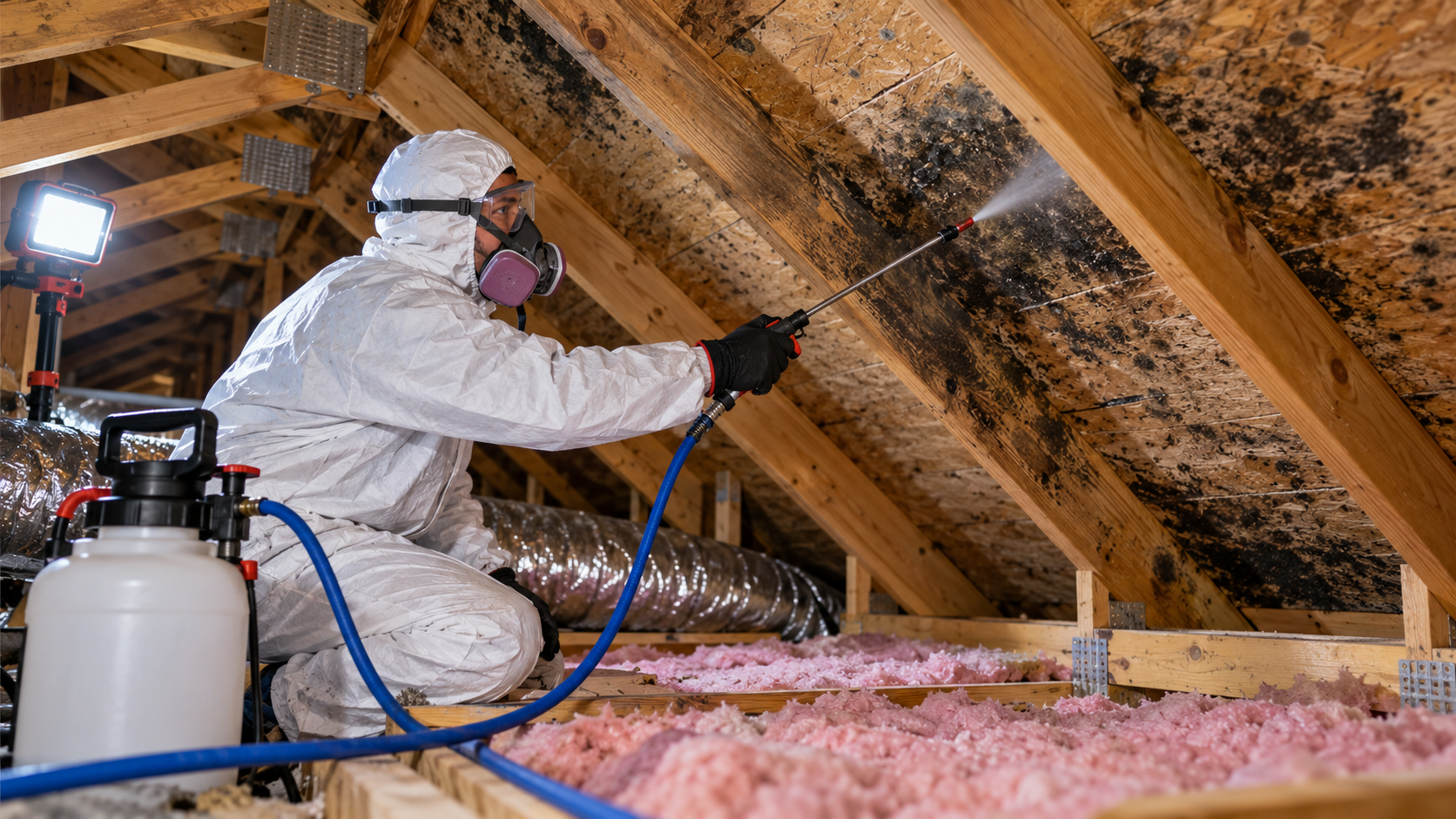
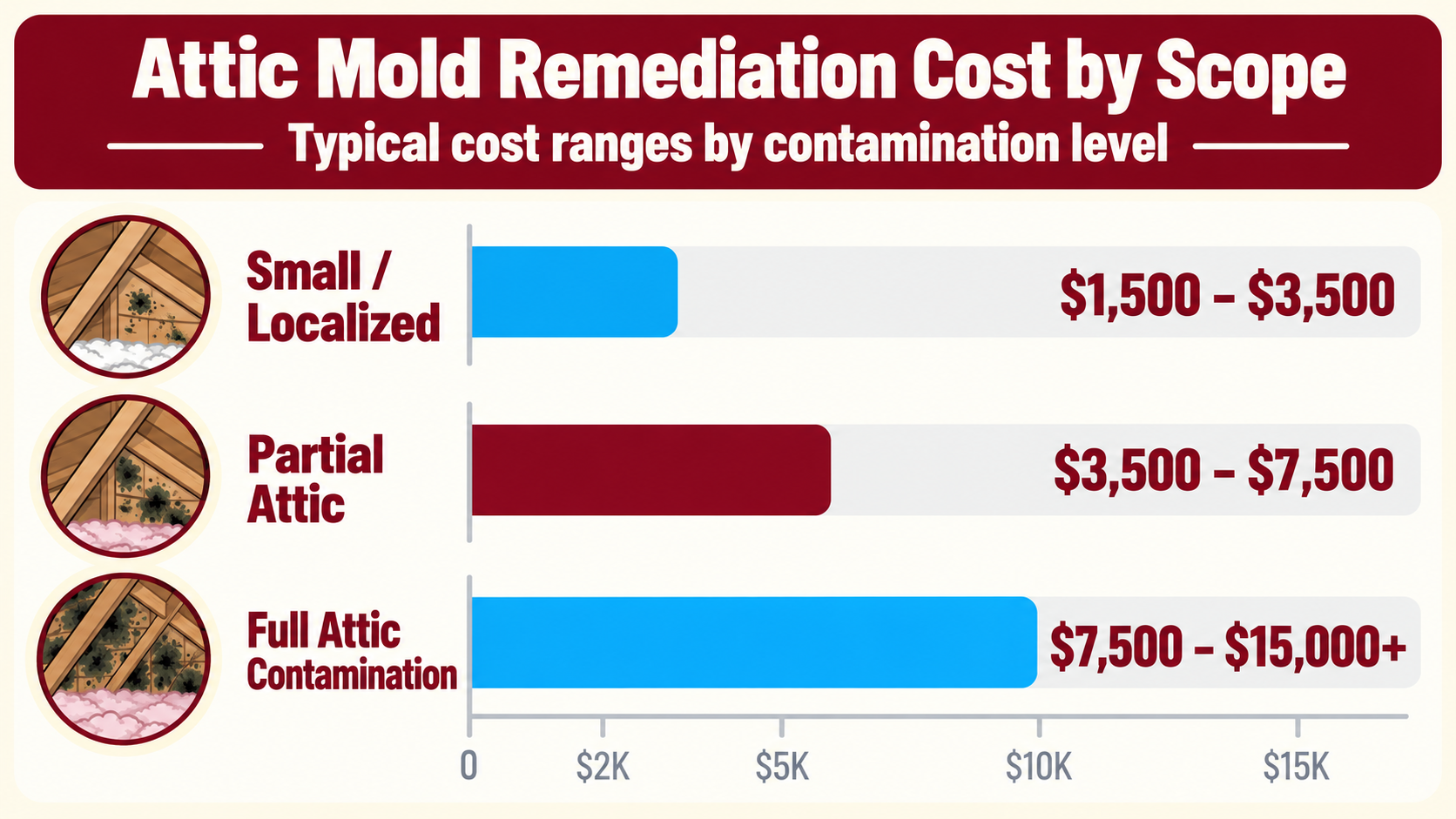
Removing black mold from an attic in New Jersey typically costs $1,000 to $4,000 for most homes, with severe or widespread cases running $6,000 to $15,000 when insulation, sheathing, and structural framing are all affected. A small, isolated patch on a single rafter can be treated for as little as $500, while whole-attic contamination tied to a long-term roof leak or poor ventilation can exceed $9,000 before any related repairs.
The price depends almost entirely on three things: how much square footage is affected, whether the insulation needs to be removed and replaced, and how hard the attic is to physically access. Black mold itself isn’t what drives the number up — scope and access are, which is worth understanding before comparing quotes.
Average Cost to Remove Black Mold from an Attic in NJ
| Scope | Typical NJ Cost |
| Small, isolated patch (under 10 sq ft) | $500 – $1,500 |
| Partial attic contamination (10–100 sq ft) | $1,000 – $4,000 |
| Full attic contamination | $6,000 – $15,000 |
| Severe cases (structural framing + insulation) | $9,000+ |
| Mold inspection/testing | $300 – 1,000(avg.~657) |
| Insulation replacement (add-on) | $1.00 – $4.50 per sq ft |
Why Attic Mold Costs More to Remove Than Mold in Other Rooms
Attic mold removal runs higher than a comparable job in a bathroom or basement for a straightforward reason: access. A bathroom wall is easy to reach, has standing headroom, and rarely involves structural wood. An attic usually has limited headroom, exposed rafters and sheathing instead of finished drywall, and often insulation that has to be bagged and removed before the wood underneath can even be treated.
That combination — restricted access, more exposed wood surface area, and insulation disposal — is why a partial attic job (1,000–4,000) can cost more than a similarly sized bathroom job (500–1,000), even when the square footage is comparable.
Is Black Mold More Expensive to Remove Than Other Mold?
Sometimes, but not because black mold itself is harder to kill. Industry cost data puts black mold remediation around $2,000 to $10,000, compared to roughly $1,500 to $6,000 for common green mold and $500 to $4,000 for Aspergillus. The gap exists mainly because contractors often apply stricter containment and PPE protocols when black mold (commonly Stachybotrys) is suspected or confirmed, not because the organism requires fundamentally different removal chemistry.
The EPA’s own guidance on mold and health doesn’t single out black mold as uniquely dangerous compared to other indoor molds — it treats mold broadly as a source of allergens and irritants, and recommends removal based on visible growth and moisture, not on identifying the exact species first. In practice, that means the smartest move with any attic mold is removal based on scope, not waiting on a lab report to confirm color or species before acting.
What Affects Your Attic Mold Removal Cost
Square footage affected is the baseline driver — contractors typically price in bands (small, partial, full) rather than a flat per-square-foot rate, because attic work doesn’t scale linearly the way an open room does.
Whether insulation needs replacement is often the single biggest line item beyond labor. Contaminated insulation can’t be cleaned and reused; it has to be bagged, removed, and replaced at $1.00 to $4.50 per square foot.
Roof framing material matters too: plywood or OSB sheathing with surface mold can often be cleaned and treated, while sheathing that’s been saturated and softened by a long-term leak may need to be replaced outright, adding carpentry cost on top of remediation.
Access and attic height change labor time directly — a walk-up attic with standing headroom is faster to work in than a cramped knee-wall or scuttle-hole attic, and contractors price that difference into labor hours.
Does Attic Insulation Have to Be Removed If There Is Mold?
Usually, yes, if the insulation itself is contaminated. Mold growing on or through fiberglass or cellulose insulation can’t be effectively cleaned in place, since the fibrous material holds spores the way a sponge holds water. Insulation sitting near mold but not directly contaminated may be salvageable — exactly the kind of judgment call a proper inspection is for, rather than a blanket “always replace” or “never replace” rule.
Can Attic Mold Be Treated Without Replacing the Sheathing?
Often, yes. Surface mold on sheathing and framing is typically removed through media blasting (dry ice or soda blasting) or HEPA-vacuuming and antimicrobial treatment, followed by a protective coating applied to the treated wood to help prevent future growth and extend its lifespan. Sheathing replacement is usually reserved for wood that’s structurally compromised — soft, delaminating, or rotted from sustained moisture — not simply because mold grew on the surface.
What Causes Black Mold in a NJ Attic
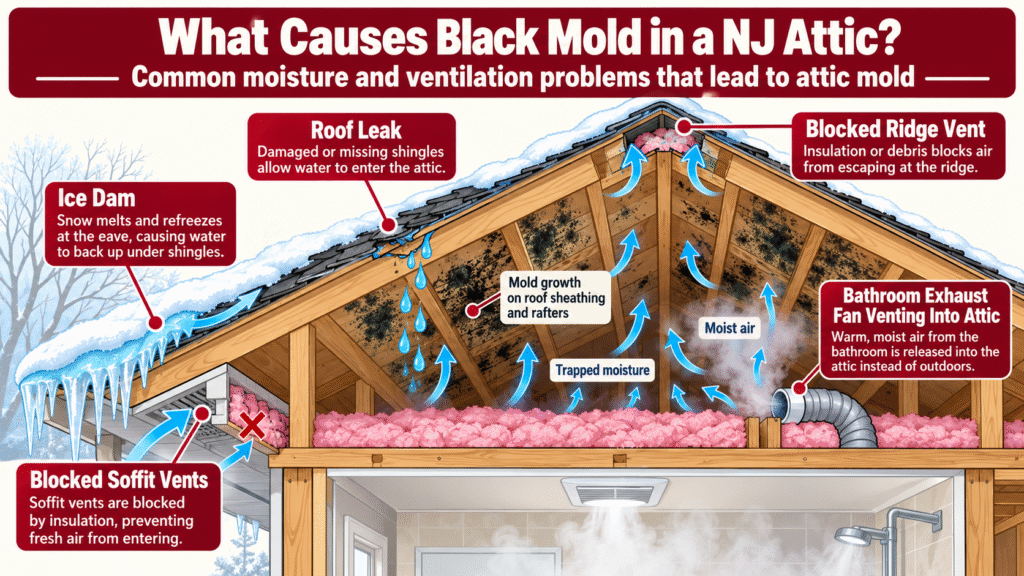
Attic mold almost always traces back to moisture getting in or being trapped, not to the attic being inherently prone to mold. The most common causes in New Jersey homes are poor or blocked soffit and ridge ventilation, which traps warm, humid air against the roof deck; bathroom or kitchen exhaust fans vented into the attic instead of outside, a surprisingly common builder shortcut that constantly pumps moisture into the space; roof leaks around flashing, vents, or aging shingles; and ice dams in winter, which force meltwater back under shingles and into the attic below.
Because the underlying cause is almost always moisture and airflow, removing the mold without fixing the ventilation or leak that caused it typically means the mold comes back.
Is Black Mold in the Attic Dangerous?
It can be, primarily for respiratory and allergy symptoms rather than as a uniquely toxic substance. The EPA’s guidance on mold and health describes mold generally as a producer of allergens and irritants that can trigger hay-fever-like symptoms, asthma attacks in people who are sensitive, and irritation of the eyes, skin, nose, throat, and lungs — this applies to mold broadly, not specifically to black mold over other types.
What makes attic mold worth addressing promptly isn’t that it’s more dangerous sitting in the attic than elsewhere — it’s that attic air gets pulled into the living space through the stack effect (warm air rising and drawing attic air down through gaps, can lighting, and the attic hatch), so mold spores in an unaddressed attic don’t necessarily stay contained to the attic.
Does Homeowners Insurance Cover Attic Mold Removal?
Usually not, and the reason is specific to how attic mold typically develops. Homeowners insurance generally covers mold removal only when it results from a sudden, accidental covered peril — a burst pipe or a storm-caused roof failure.It typically excludes mold caused by gradual issues like a slow roof leak, condensation from poor ventilation, or moisture that built up over weeks or months.
Since most attic mold in NJ comes from exactly those gradual causes — blocked ventilation, a long-standing minor leak, ice dam backup over a season — it often falls outside what a standard policy will pay for. Checking your specific policy and documenting when the moisture source started (sudden vs. ongoing) is worth doing before assuming either way.
How to Get an Accurate Price (Not a Guess)
Every range here is a starting point. The only way to know your actual number is to have someone look at the affected square footage, the insulation, the sheathing condition, and the moisture source causing it.
MMRG Mold Remediation & Basement Waterproofing offers a free attic mold inspection for New Jersey homeowners — not a sales visit, an inspection that identifies the scope, the cause, and what it will actually take to fix it long-term. Inspections are led by Randy Cece, who holds certifications across five accrediting bodies, including Certified Mold Assessor (EAA), Indoor Air Quality Technician (ESA), and Council-Certified Microbial Investigator/Consultant training, with documented credentials dating back to 2002.
MMRG also backs its pricing with a 10% price-match guarantee against other licensed NJ competitors, and because attic mold is frequently tied to a moisture source elsewhere in the home — a roof leak, poor ventilation, sometimes a connected basement or crawl space issue — inspections look at the cause, not just the attic itself, so you’re not paying for mold removal twice because the real source went untreated.
See the full scope of attic mold removal and insulation replacement on the attic mold removal service page, or call to schedule a free inspection.
Ready to find out exactly what your attic will cost to treat?
Schedule a free, no-obligation attic mold inspection with MMRG Mold Remediation & Basement Waterproofing. A certified technician will assess the affected area, identify the moisture source, and provide a clear, written scope of work — backed by our 10% price-match guarantee against other licensed NJ contractors. Visit the attic mold removal service page or call 908-601-1307 to schedule your inspection.
FAQ
Does attic mold mean I need a new roof?
Not necessarily. Mold growing on sheathing or framing doesn’t automatically mean roof replacement — most attic mold is a surface and moisture problem resolved through cleaning, treatment, and fixing ventilation or a leak. A new roof becomes relevant only if the roofing material itself has failed structurally, which is a separate question from mold remediation.
Can I sell a house with mold in the attic?
Yes, but it typically has to be disclosed, and it usually surfaces during a home inspection before closing. Unaddressed attic mold commonly becomes a negotiating point — buyers often ask for remediation before closing or a price credit to cover it — so resolving it ahead of listing is usually cheaper than negotiating it mid-contract.
Will attic mold come back after removal?
It can, if the moisture source that caused it wasn’t fixed. Mold removal that doesn’t address blocked ventilation, a roof leak, or a misvented exhaust fan is treating the symptom, not the cause — which is why a thorough inspection identifies and fixes the source as part of the job, not as a separate step.
How long does attic mold removal take?
A small to partial job typically takes 1 to 2 days. Full attic remediation with insulation removal and replacement usually takes 2 to 4 days, longer if sheathing replacement or ventilation repair is part of the scope.
Why does mold remediation cost vary so much?
“Mold remediation” covers everything from a $500 spot treatment on a single joist to a $15,000+ full-attic job with insulation and sheathing replacement. The honest answer to “how much does mold remediation cost” is always a range until someone has actually measured the affected area and assessed what needs replacing versus treating.